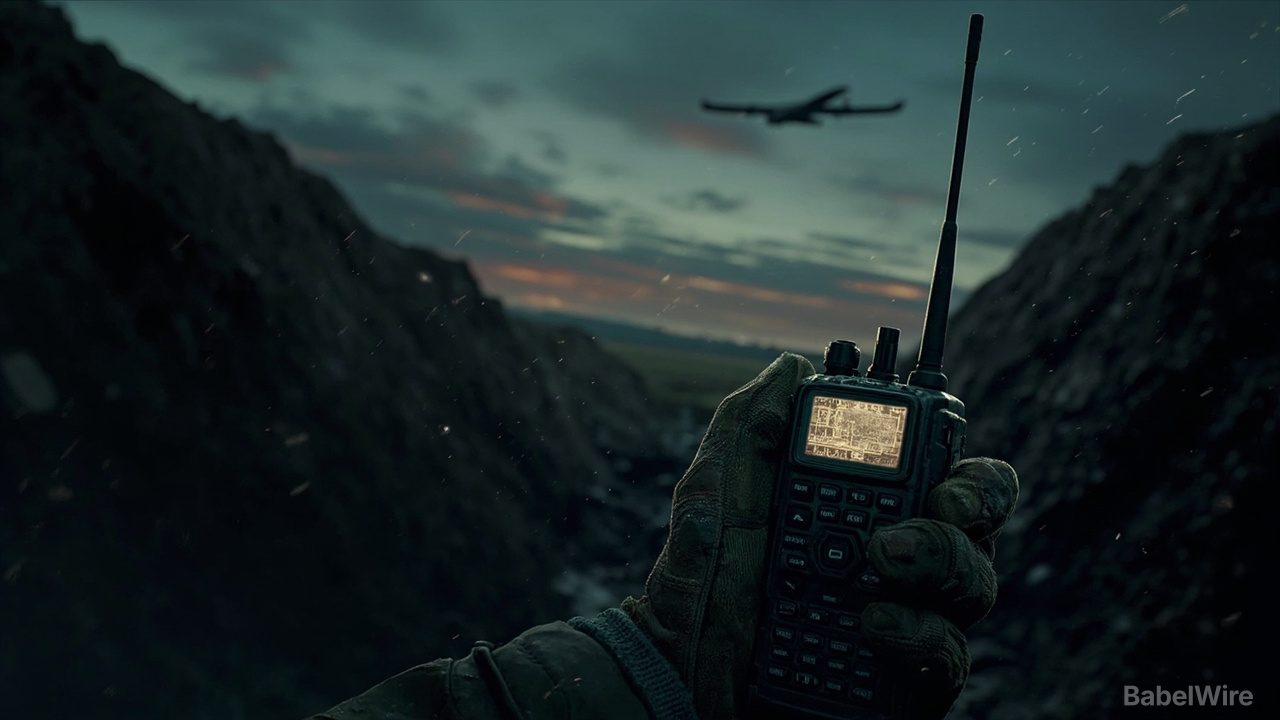
A 280-gram receiver built in Kyiv lets Ukrainian drone teams read over the shoulder of Russian reconnaissance drones.
The device is called D·Vision SDR and comes from a startup called CODE380. It is a software-defined radio: rather than merely announcing that a drone is transmitting somewhere, it decodes the analogue video signal and puts the picture on a screen. Because many Russian drones send their video over the air unscrambled, anyone with the right receiver can watch along.
**The numbers.** According to Defense News, the device weighs about 10 ounces — less than half the weight of competing Ukrainian models, one of which runs to a couple of pounds. CODE380 puts the range at up to 10 kilometres (six miles), across frequencies from 540 MHz to 6 GHz.
**Why it matters tactically.** A unit can see where a drone is heading and what its pilot is aiming at before the strike lands. And because the receiver also listens on the channels Russia's newer Molniya drones began using for video in June, it closes a specific gap: Serhii "Flash" Beskrestnov, a radio specialist who advises Ukraine's president, wrote on Facebook in June that "most detectors don't see these frequencies, or see them poorly." He warned at the same time that putting too much trust in a detector could prove fatal.
**The countermeasure is already moving.** The advantage has an expiry date, and Ukrainian specialists say so themselves. Digital video replacing analogue would blind receivers like this one, because the signal stops being trivially readable. The New York Times reported in August that some Molniyas are already AI-guided, using Nvidia chips on board and emitting no signals at all. Fibre-optic drones, steered over a physical cable, likewise radiate nothing a radio receiver can catch.
**A pattern that keeps repeating.** Each side in this war has repeatedly learned that a technical edge lasts months, not years. The cheap, fast receiver is a good example of the strength of Ukrainian defence innovation: small, inexpensive, and taken from idea to field-ready in a few months. It is also an example of its limit — it exploits a weakness in the opponent's kit that the opponent is currently removing.
For the units at the front, that makes the device a tool for a season rather than a permanent condition. Anyone planning on the assumption that the other side keeps broadcasting in the clear is planning on an assumption that is already disappearing.