The Dinosaur That Died With Its Killer's Tooth Still Inside
Paleontologists have unearthed a fossil of such rare and visceral detail that it reads like a Jurassic Park scene made real: a herbivorous dinosaur with a Tyrannosaurus rex tooth still embedded in its skeleton — the first definitive proof of a T. Rex attack preserved in the fossil record.
The Discovery
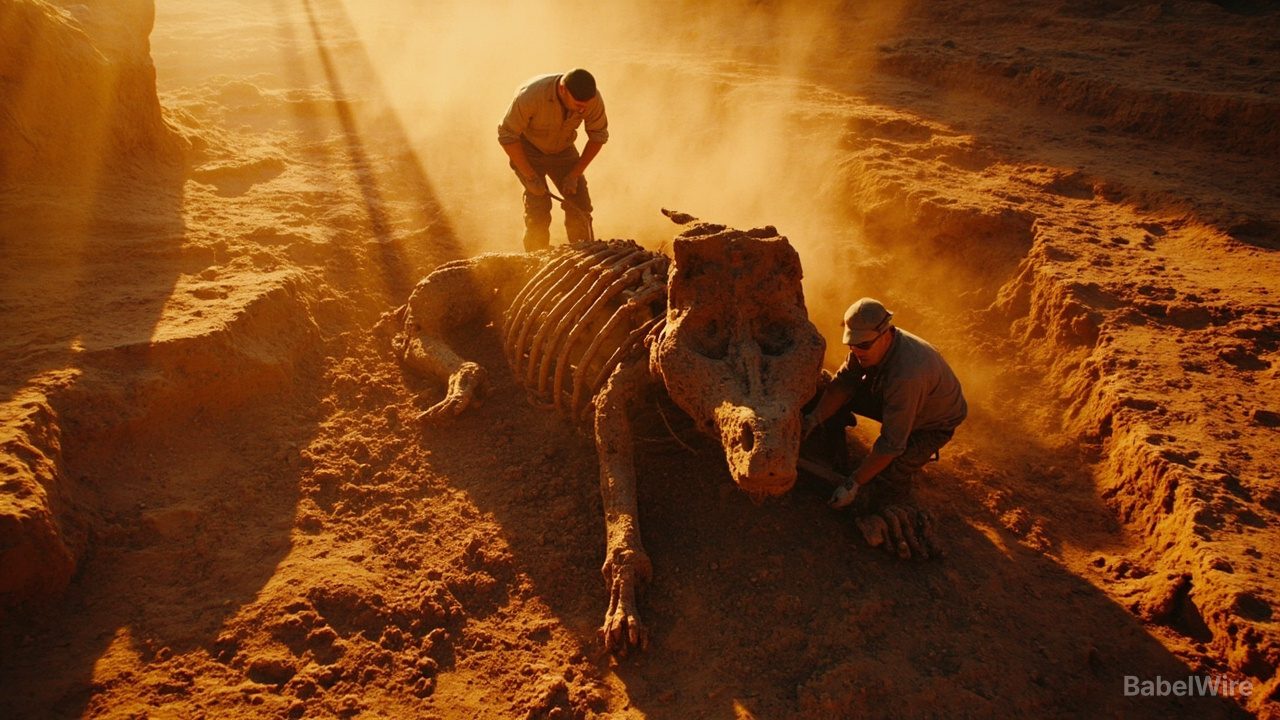
The fossil, discovered in the Hell Creek Formation of Montana, preserves the skeleton of a Chasmosaurus — a medium-sized ceratopsian dinosaur — with a serrated T. Rex tooth lodged in its pelvic bone. The tooth tip penetrated 4.3 centimeters into the bone, and the surrounding bone shows clear signs of healing, indicating the Chasmosaurus survived the initial attack before eventually dying — likely from infection or being brought down by the same predator.
"This is the smoking gun of dinosaur predation," said Dr. Sarah Manning, lead author of the study published in PeerJ. "We've found T. Rex teeth near herbivore skeletons before, but never embedded in the bone with healing around it. This tells us the animal fought back and survived the attack, at least for a while."
What the Fossil Reveals
CT scans of the fossil reveal extraordinary detail: - The tooth is a subadult T. Rex tooth, suggesting a younger individual (around 10-12 tons) made the attack - The bite force was estimated at 18,000 Newtons — less than an adult T. Rex's 35,000N maximum - The Chasmosaurus' pelvis shows signs of infection around the wound, suggesting it lived for weeks or months after the attack - A matching broken tooth fragment was found 11 meters from the main fossil, likely the tip that broke off during the struggle
Why This Matters
Direct evidence of predator-prey interactions in dinosaurs is extraordinarily rare. Most fossils are bones that accumulated after death — scavenging, not hunting. This specimen preserves a moment of life, not death, offering scientists an unprecedented window into the behavior of the most famous predator in Earth's history.
"This tells us T. Rex didn't just scavenge — it hunted," said Dr. Manning. "And it tells us that even when prey survived an attack, the wounds were often fatal. The terror of the Cretaceous wasn't just about being eaten alive. It was about being wounded, escaping, and slowly dying from infection weeks later."