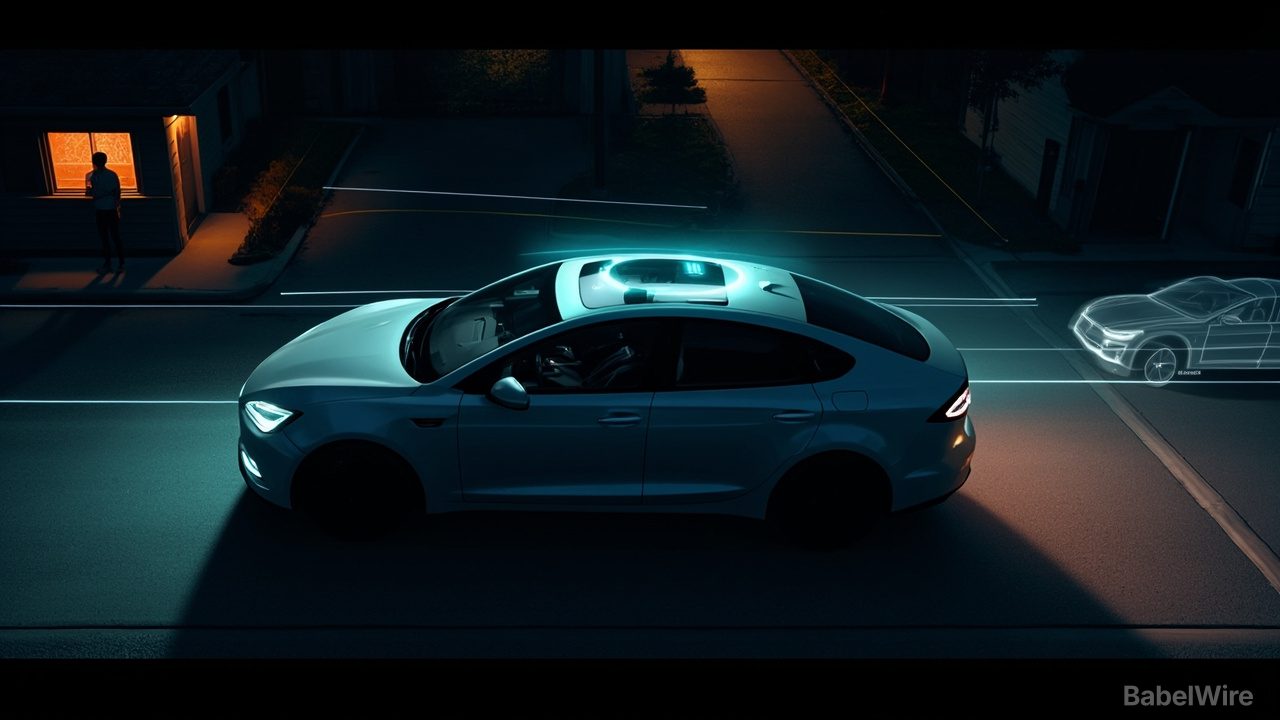
Tesla used its third-quarter 2026 earnings call to revive one of its oldest promises: that customers will be able to add their own vehicles to the company's robotaxi fleet, starting next year. The company has framed the idea for a decade as the logical end state of autonomy — a privately owned car that earns money while its owner is at work, instead of depreciating in a parking space. What the call did not provide is the part that determines whether it happens: terms.
That gap is worth dwelling on, because the owner-fleet model is not primarily a software milestone. It is an insurance product, a liability framework, and a utilization business, and each of those has a harder problem inside it than the driving itself.
The promise has a long history. Tesla has described an owner-operated ride network since its second master plan, and executives have repeatedly put a date on it — dates that arrived without the network. The current version is more credible than earlier ones in one respect: Tesla now operates paid driverless service in a growing set of markets, so the dispatch, cleaning, charging, and remote-assistance machinery that an owner fleet would plug into actually exists. That machinery, not the self-driving stack, is what previous promises lacked.
Insurance is the binding constraint. A car operating commercially is not a car operating privately, and insurers price that difference brutally. Who holds the policy while the vehicle is carrying a paying passenger? If Tesla holds it, the company is underwriting its own hardware's behavior at fleet scale — an exposure that grows with every owner who joins. If the owner holds it, retail insurers will need products that cover commercial ride-hail use of a vehicle with no driver, and those products barely exist as standard offerings. Most likely outcome is a hybrid: Tesla provides coverage during robotaxi mode, the owner covers the rest, and the boundary between the two becomes the most litigated sentence in the contract.
Utilization math decides adoption. An owner-fleet car has to earn more than it costs to be away from its owner: depreciation per mile, cleaning, charging time, tire wear, and the opportunity cost of not having the car. Robotaxi demand is also peaky — concentrated in evenings and weekends, exactly when owners most want their own vehicle. Tesla has never published a revenue-share structure, a per-mile earnings estimate, or a guarantee about how many hours a car will be dispatched. Without those numbers, "add your car to the fleet" is a feature announcement, not an economic proposition, and owners who ran the arithmetic on earlier versions concluded the car works harder than they do.
Regulation is state-by-state and unimpressed by ambition. Paid driverless service requires permits, and the frameworks being built now in the US generally assume an operator — a company with a safety case, a remote-assistance desk, and an incident-reporting obligation. An individual owner is not an operator. Whether regulators accept Tesla as the operator of a vehicle it does not own is the central legal question, and it is unanswered in every market that matters.
Why it might still work: Tesla's vertical integration is real. It builds the car, the compute, the insurance arm, and the service network, and it can change vehicle behavior with an over-the-air update in a way no competitor can. If any company can make the paperwork follow the software, it is the one that already owns every layer. The Cybercab program, with a vehicle designed from the start without a steering wheel, shows the company is willing to redesign the hardware to fit the business model rather than the reverse.
The Verge's framing — will it happen? — is the right one, and the honest answer is that the technology is no longer the bottleneck. The bottleneck is a set of commercial and legal arrangements nobody has yet published, for a product whose value proposition depends entirely on their details. Tesla has until next year to publish them. Watch for three things: a named insurance partner, a stated revenue split, and a state that formally designates Tesla as operator of owner-owned vehicles. Any one of those would move this from recurring promise to actual plan.