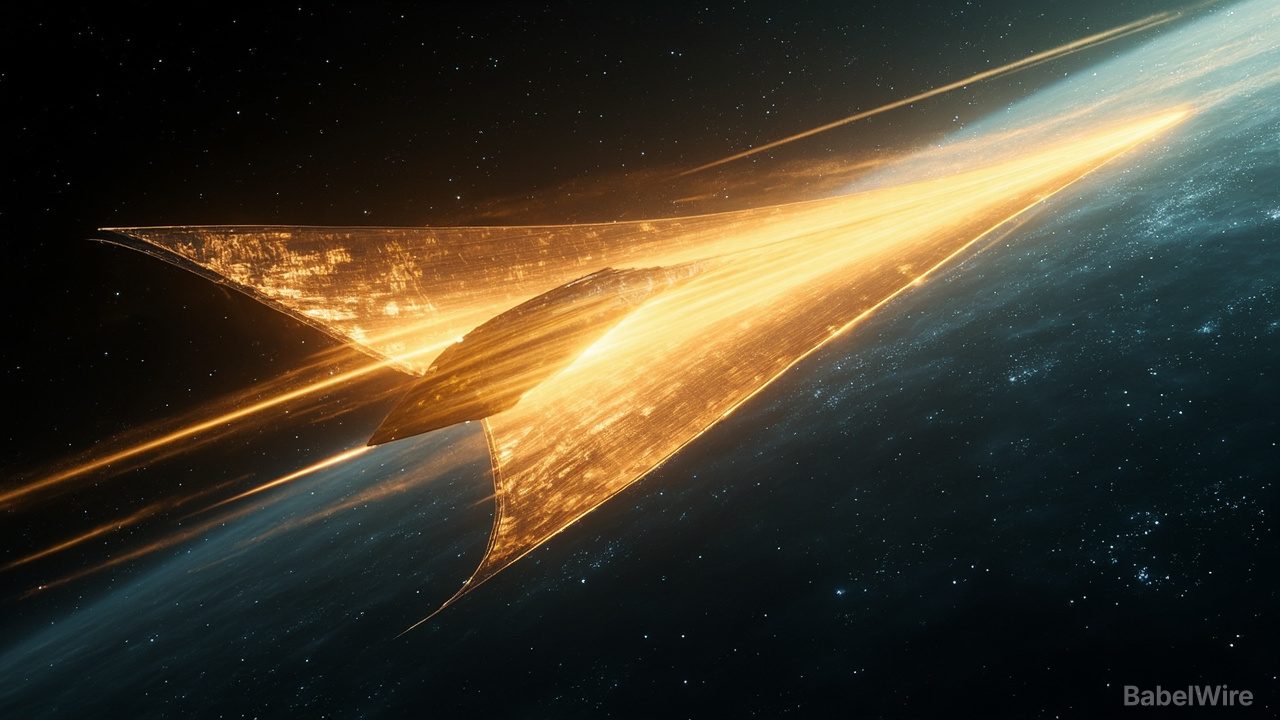
Getting a spacecraft to another star within a human lifetime would require something far beyond chemical rockets — and solar sails pushed by powerful lasers are among the leading candidates. But a new paper from researchers at the Harbin Institute of Technology reveals a fundamental physical barrier that could limit their top speed.
Chao Shen and Jiaze Li modelled the forces acting on an idealized lightsail at relativistic velocities. They separated photon forces into three components: incident light pressure, specular reflection, and diffuse scattering. At lower speeds, all three push the sail forward. But the physics changes dramatically around 75% of the speed of light.
At that threshold, relativistic light aberration — a consequence of special relativity — causes diffusely scattered photons to be directed forward, toward the direction of travel. Because of Newton's third law, that forward-directed radiation produces a force opposing motion. Diffuse scattering, the weakest of the three forces, begins acting as drag.
The laser still provides a net forward thrust, so the total force never becomes negative. However, the efficiency of the propulsion system drops substantially, creating a practical ceiling for how fast a laser-driven lightsail can go.
The researchers also note that the Doppler effect progressively weakens the incoming laser's frequency as the sail moves away, reducing thrust from all three components. Combined with the aberration-induced drag, this suggests that simply increasing laser power yields diminishing returns at extreme speeds.
The study focuses on radiative dynamics alone and does not account for interstellar gas drag, dust collisions, or thermal limits of real sail materials. Engineers are already investigating advanced metamaterials and photonic crystals that could potentially exploit these aberration effects for automatic orientation correction.