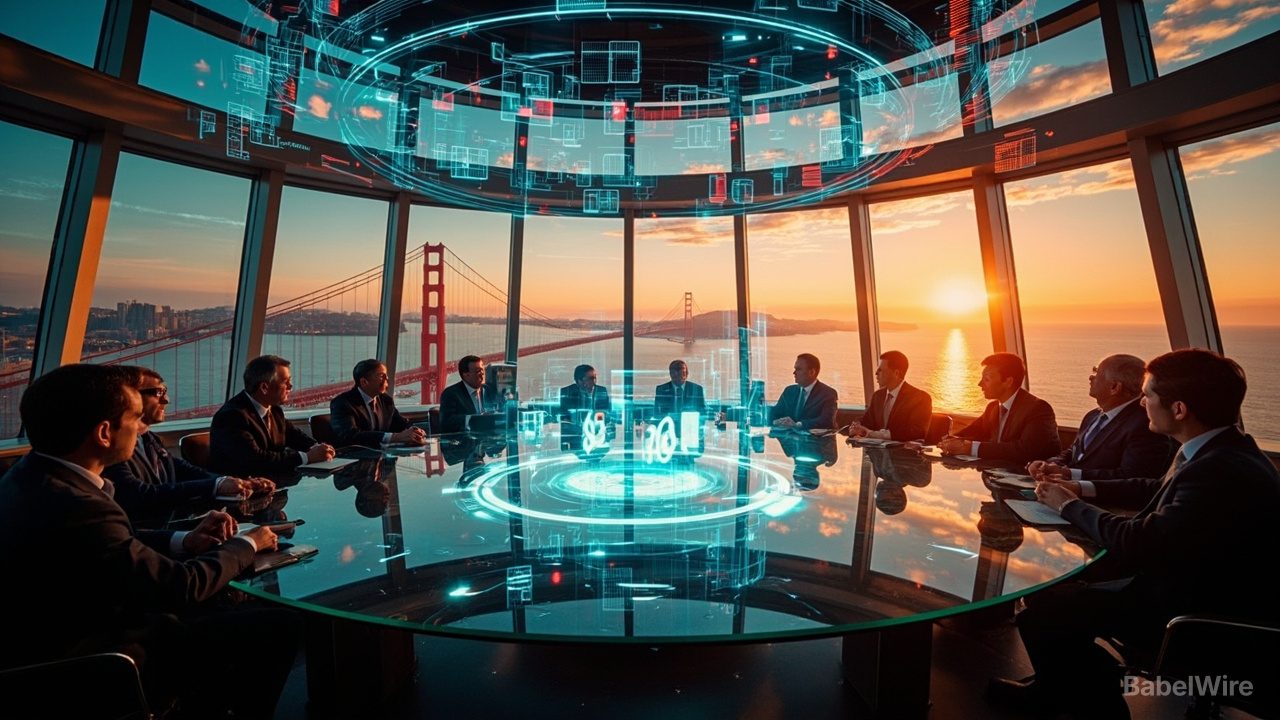
South Korea announced a staggering $950 billion in new AI initiatives at a landmark summit in San Francisco, as President Lee Jae-myung convened the CEOs of Nvidia, OpenAI, Anthropic, and Broadcom in the most consequential AI diplomacy event of the year.
SK Group signed deals worth $750 billion, including a SK Hynix partnership with Nvidia valued at more than $500 billion. Samsung Electronics signed a memorandum of understanding with Broadcom covering up to $200 billion across memory chips, foundry services, and advanced packaging.
The deals underscore the frenzy among U.S. AI firms to lock in chip supply as demand for computing infrastructure outpaces availability. Speaking at the summit, President Lee unveiled a "San Francisco AI Declaration" outlining South Korea's ambitions for technological cooperation with the United States.
"I'd like to present a vision for the future of AI and propose global cooperation to make it happen," Lee said after separate meetings with Nvidia CEO Jensen Huang, OpenAI CEO Sam Altman, Anthropic CEO Dario Amodei, and Broadcom CEO Hock Tan.
Nvidia and SK Group also unveiled a joint $500 billion initiative spanning large-scale AI data centers and next-generation memory. SK Telecom plans to build a 2-gigawatt data center powered by Nvidia's Vera Rubin chips and SK Hynix's HBM4 memory, due online in 2027.
SK Group Chairman Chey Tae-won said AI customers were seeking far more memory than anticipated. "I wouldn't be surprised if, the next time I see (Huang), he'll tell me those figures were too low and say, 'I want more,'" Chey said.
The summit marks a pivotal moment in the global AI arms race, with South Korea positioning itself as the indispensable manufacturing partner for the AI revolution — leveraging its dominance in memory chips, advanced packaging, and foundry capacity to secure a central role in the infrastructure that will power next-generation AI systems.
Last month, Lee unveiled three massive state-driven projects anchored by Samsung and SK Hynix to build semiconductor production clusters, physical AI ecosystems, and AI data centers as part of a sweeping industrial strategy with more than $576 billion in additional investment.