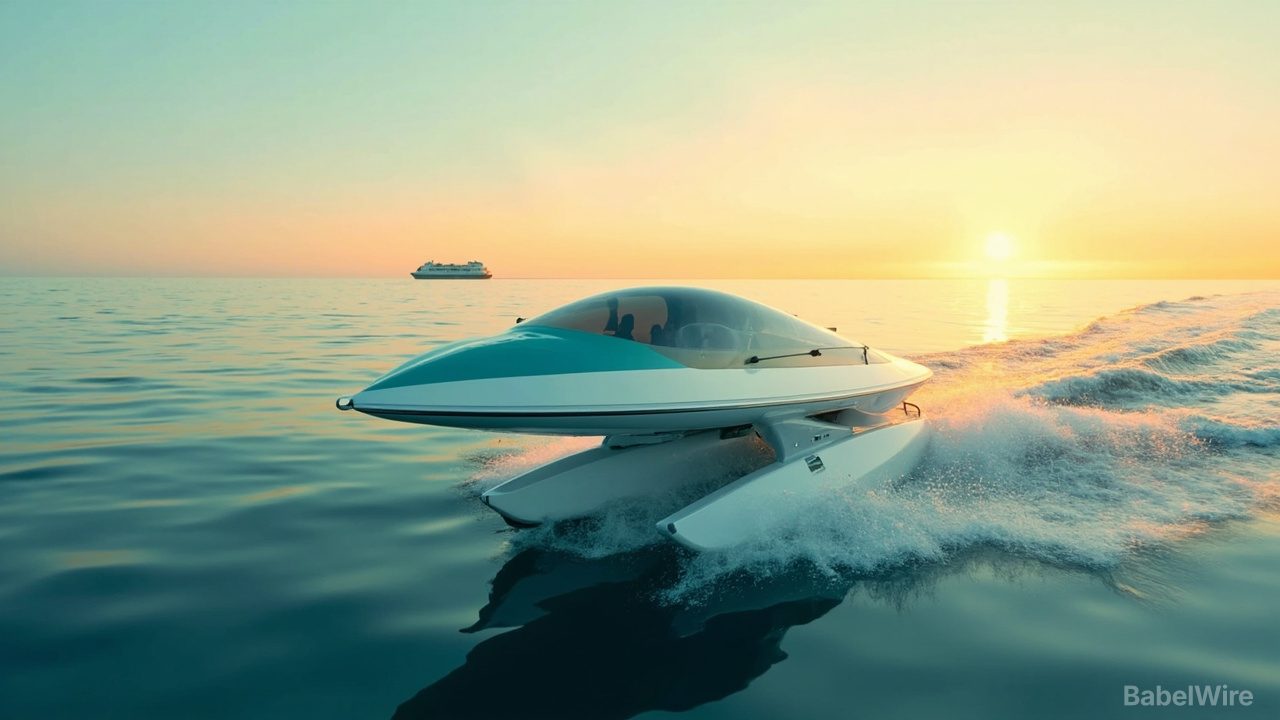
Ground effect — the extra lift and reduced drag an aircraft picks up when it flies close to a fixed surface — has been flirted with since the Cold War. REGENT Craft, founded by two MIT alumni, thinks it is finally viable as commercial transport.
The company's passenger vessel, the Viceroy, first flew in September 2026 as the largest all-electric wing-in-ground-effect craft built to date, with a 65-foot wingspan, and REGENT says it can now cover up to 750 kilometres. It works like a boat, a hydrofoil and an aircraft in sequence: it floats in harbour, hydrofoils up to take-off speed even in rough water, then flies just above the surface at speeds up to 180 miles per hour.
"This is six times faster than a ferry and will be half the cost of an airline ticket," founder Billy Thalheimer said. "We're flying on a cushion of air just like a bird skimming over the surface."
The founders, Thalheimer and Mike Klinker, both studied at MIT and worked at Aurora Flight Sciences, where Thalheimer found that a battery-electric aircraft limited to low altitude could manage only about 50 miles per charge — the constraint that pushed them toward flying over water, where the ground effect does the work of climbing.
REGENT has opened a 255,000-square-foot manufacturing facility in North Kingstown, Rhode Island, capable of producing about 70 passenger seagliders a year, and expects the first production vessels toward the end of 2027. Investors include Alaska Airlines, Japan Airlines and Lockheed Martin, and the founders say there is a large order backlog.
A smaller autonomous variant, Squire, has already flown simulated logistics and medical-evacuation missions with the U.S. Marine Corps; it carries up to 50 pounds and covers 100 nautical miles per charge at 80 miles per hour. Because the vessel stays over water, REGENT argues the regulatory path is simpler than for electric aircraft that must climb away from the surface.
"We've really derisked the technology at this point," Thalheimer said. "Both of our vessels have gone through float, foil and fly operations, and the performance has been really good, so now we're full speed ahead moving into production."
The pitch rests on geography: 40 percent of the world's population lives in and around coastlines, and REGENT argues that maritime transport has underused infrastructure — while regional travel has barely moved since the 1950s, "and yet, if anything, it takes longer to do a lot of the regional missions now because we have more traffic and congestion," Thalheimer said.
Sources
- golem.deGolem: Bodeneffekt – Batteriebetriebener Seegleiter soll Fähren ersetzen
- news.mit.eduMIT News: Electric seaglider created by MIT alumni takes flight
- regentcraft.comREGENT: world's first human-crewed Seaglider flight
- aerospaceglobalnews.comAerospace Global News: REGENT advances Seaglider to production with first crewed flight


