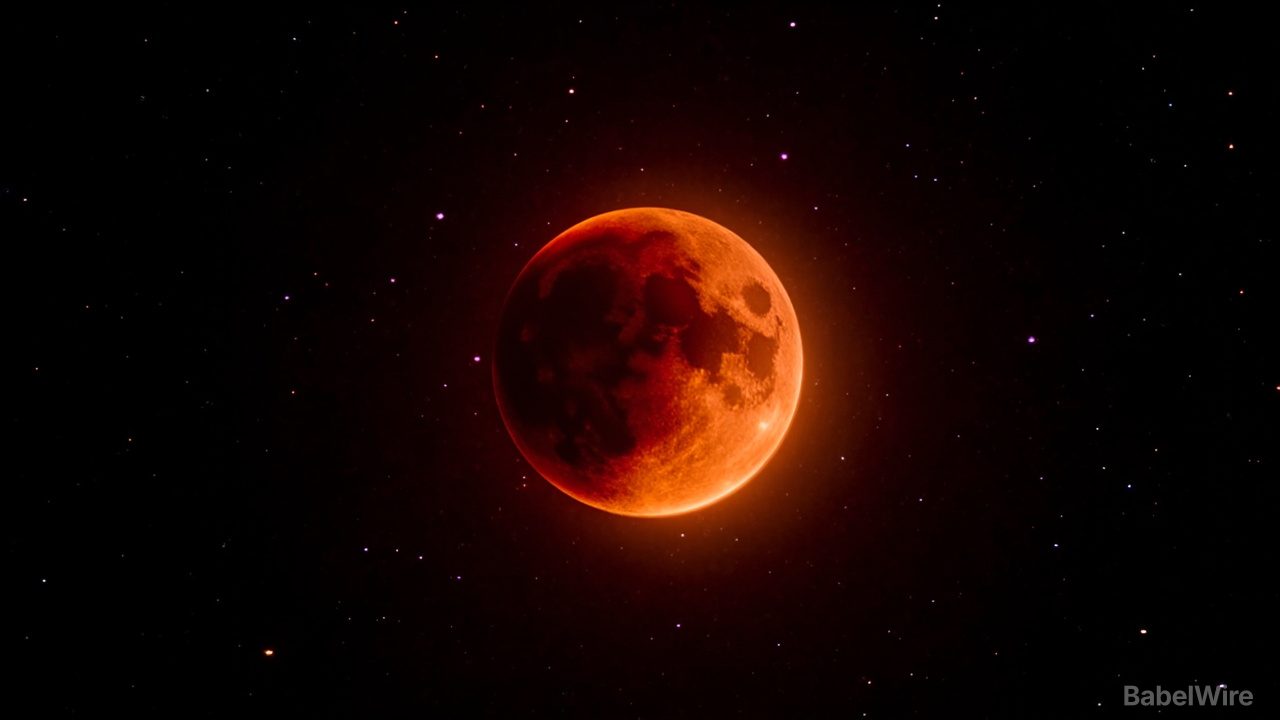
A spectacular 96.2% partial lunar eclipse on the night of August 27-28 turned the Moon a deep blood red across North and South America, with millions of people watching the near-total event live.
The eclipse was deep enough to produce a vivid blood moon effect, with Earth's shadow covering nearly all of the bright lunar disk and causing a distinctive reddish-orange hue on the Moon's surface. The event was visible throughout the Americas except Alaska and northwestern Canada, as well as parts of western Europe and western Africa.
The Royal Observatory Greenwich reported that from the UK and Ireland, around 93% of the Moon was in shadow during the early hours of August 28. The event was the deepest partial lunar eclipse visible from the Americas in several years.
Multiple observatories and science communicators hosted live streams of the event, with timeanddate.com and other platforms broadcasting the eclipse as it unfolded. Social media was flooded with photographs from amateur and professional astronomers across the hemisphere.
The partial lunar eclipse occurred at the Moon's ascending node, with the umbral magnitude reaching 96.2% — just shy of a total eclipse. The next lunar eclipse visible from the Americas will not occur for some time, making this a rare viewing opportunity for skywatchers across the Western Hemisphere.
Sources
- timeanddate.comPartial Lunar Eclipse August 27-28 | Time and Date
- space.comPartial lunar eclipse August 27-28 guide | Space.com
- skyandtelescope.orgPartial Lunar Eclipse on August 27-28 | Sky and Telescope
- wired.comHow to See the Partial Lunar Eclipse | Wired
- cnn.comMillions watch partial lunar eclipse | CNN