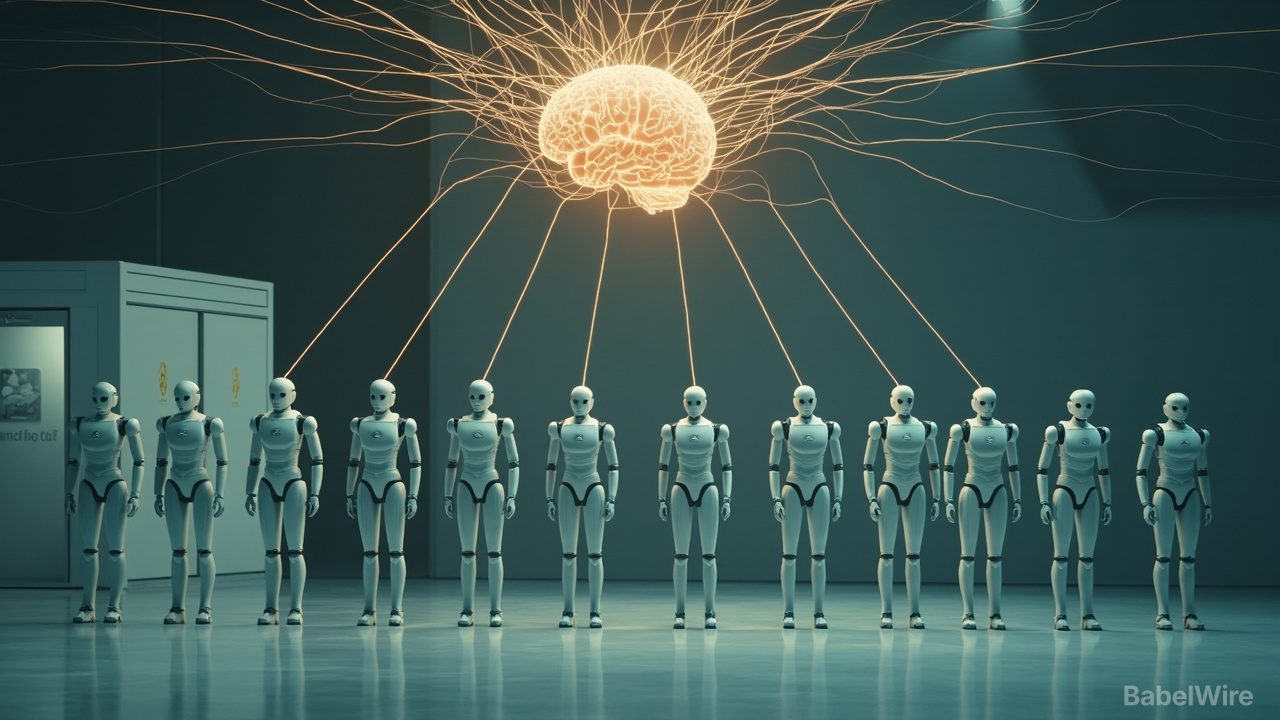
OpenAI has disbanded its stand-alone robotics team, moving its researchers onto other teams in what the company describes as a bet that general-purpose AI models can serve as the brains of robots.
The company confirmed the reorganization to Fortune. Its robotics research team has been reassigned to OpenAI's main research organisation, reporting to Chief Research Officer Mark Chen, while the applied robotics and hardware teams now sit inside the larger Applied organisation under President Greg Brockman.
The change was recent enough that OpenAI had already booked a booth at CoRL, a leading academic robotics conference in Austin this week. When Fortune visited booth 208, it was empty, with no OpenAI logo on display.
OpenAI says robotics remains a core part of its long-term vision and frames the move as acceleration rather than retreat. The company said that at the start of the year its researchers assumed the best route into robotics was to build on models such as Sora, its video generator, which learns an implicit understanding of the physical world. Since then, it says, its general-purpose frontier models — including GPT-6 Astra — have proved they can be applied directly to robots. It is the second time OpenAI has wound down a standalone robotics effort: an early team was disbanded in 2020, and a rebuilt team, announced in 2024 alongside a partnership with the startup Figure, lost that partnership in February 2025 when Figure said it would develop its own robot AI. OpenAI has said it is building its own humanoid robot, with CEO Sam Altman targeting a first public demonstration in 2027.
The move reflects a wider bet that embodied AI — models controlling robots, driverless cars and drones — is a downstream application of general intelligence rather than a special problem. In an Nvidia study, an Astra-powered agent reached a 74.8% success rate on a simulated manipulation benchmark, versus 51.0% for the best specialised robotic models on that leaderboard.
Not everyone is convinced. Guanya Shi, an assistant professor at Carnegie Mellon's Robotics Institute, told Fortune the reorganization signals OpenAI sees robotics as 'no longer a special problem.' Russ Tedrake, an MIT professor and CEO of Walden Robotics, argued robotics firms keep an edge through real-world deployment data from factory floors. Pete Florence, cofounder of Generalist, noted that large models are slow and cloud-hosted, leaving room for smaller models running onboard a robot. The reshuffle also lands as OpenAI faces pressure to cut costs after a reported $10.9 billion loss in its most recent quarter, as it seeks new funding and weighs a possible IPO in early 2027.