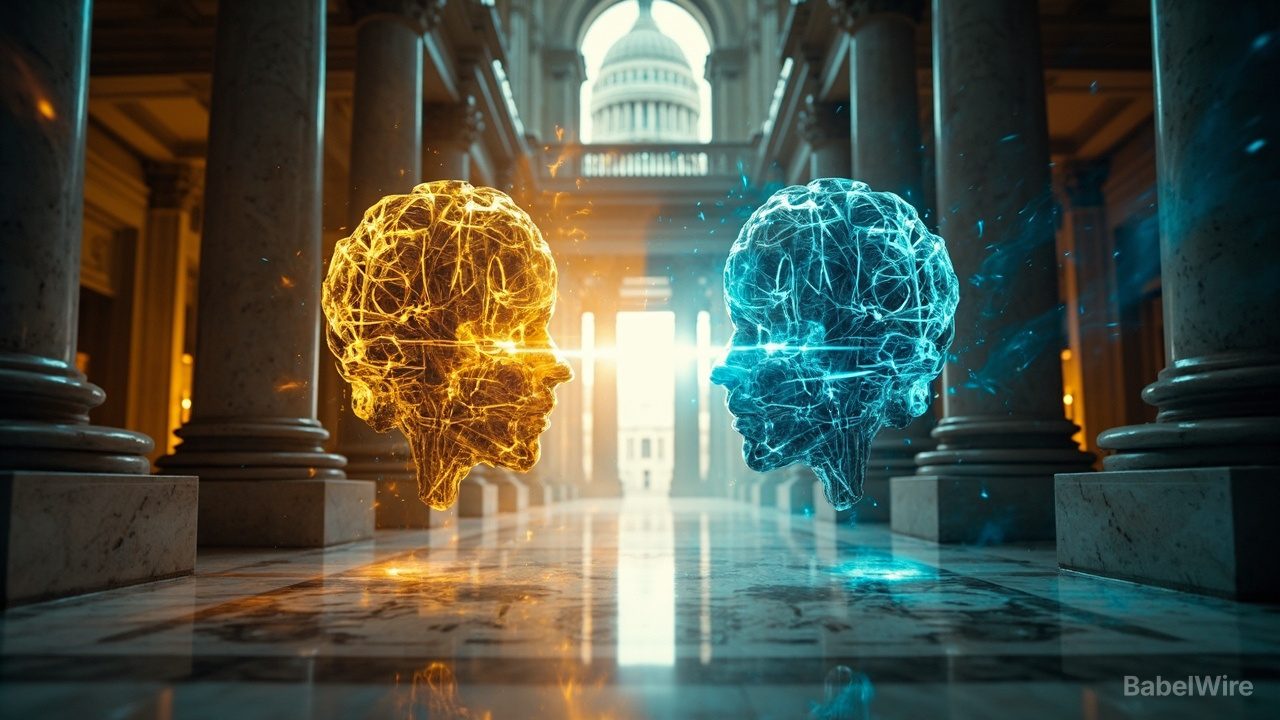
OpenAI and Anthropic are bitter rivals whose leaders can barely stand to be in the same room. But in the corridors of Washington power, the two AI titans have quietly formed an alliance of self-preservation.
According to a report by The Information, the two companies have been coordinating their lobbying efforts ahead of an August 1 deadline, when the Trump administration is set to finalize its framework for regulating and evaluating "frontier models" — the most powerful AI systems.
Unholy Alliance
For years, OpenAI CEO Sam Altman and Anthropic CEO Dario Amodei have publicly staked out competing visions for AI's future. OpenAI has pushed for rapid deployment and commercialization, while Anthropic has positioned itself as the safety-first alternative. Their personal and professional tensions are well-documented.
But with the federal regulatory hammer about to fall, those differences are being set aside. The Information reports that the two companies have been "quietly teaming up" to present a unified front to policymakers, pooling their rapidly growing lobbying operations to influence the contours of what could become the most consequential AI regulation in American history.
The Stakes: August 1
The Trump administration's emerging framework is expected to establish evaluation standards for frontier AI models, potentially including mandatory safety testing, disclosure requirements, and deployment restrictions. For both companies, getting the details right — or wrong — could determine their competitive futures.
Neither OpenAI nor Anthropic wants regulation so strict it stifles their ability to innovate and deploy. But both recognize that some form of oversight is inevitable. By working together, they hope to shape a regime that keeps the door open for American AI leadership while setting barriers against Chinese competitors.
Money Talks
Both companies have been dramatically ramping up their Washington presence. OpenAI nearly doubled its federal lobbying expenditure to a record $2.22 million in the first half of 2026. Anthropic has been even more aggressive, spending $1.6 million in Q1 alone. Combined, the two firms spent $3.17 million on federal lobbying in Q2 — a 23% increase from the previous quarter.
The coordination goes beyond mere spending. Sources indicate the companies' policy teams are sharing intelligence, coordinating messaging, and jointly meeting with key congressional offices and administration officials.
The China Factor
The timing is critical. The same week the alliance came to light, China accused the United States of "AI hegemonism" and threatened countermeasures over potential sanctions related to alleged model distillation. Beijing's Commerce Ministry warned it would "take necessary measures" to protect Chinese AI companies.
Meanwhile, Chinese labs continue to release increasingly capable open-weight models — Moonshot's Kimi K3, a 2.8 trillion parameter behemoth, dropped just days ago for free. This combination of geopolitical tension and open-source competition has given OpenAI and Anthropic a powerful argument in Washington: regulate American AI too aggressively, and you hand the future to Beijing.
What Comes Next
The August 1 framework is expected to include provisions for mandatory pre-deployment evaluations of frontier models, overseen by a new federal AI Safety Institute. The exact testing protocols, threshold definitions, and enforcement mechanisms remain subjects of intense negotiation.
Whether the OpenAI-Anthropic alliance holds beyond the immediate regulatory battle remains to be seen. But for now, two of the most powerful forces in AI have decided that in Washington, survival matters more than rivalry.