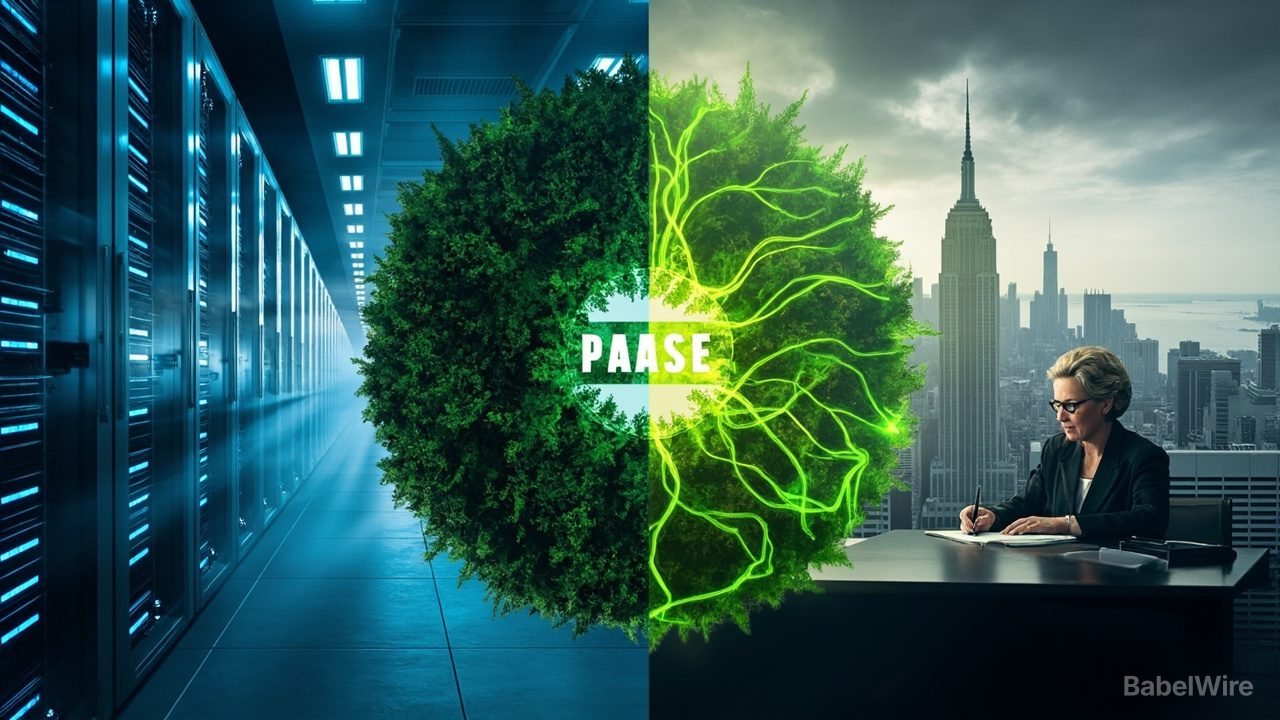
New York Governor Kathy Hochul signed an executive order on Tuesday imposing a one-year moratorium on the construction of new hyperscale data centers — the first statewide measure of its kind in the United States, and a clear signal that the energy appetite of AI is colliding with climate and infrastructure realities.
What the Order Does
The moratorium applies to new data center facilities exceeding 100,000 square feet or drawing more than 50 megawatts of power. During the 12-month pause, state agencies will develop new environmental and energy-efficiency standards governing data center construction, operation, and grid interconnection.
Hochul also announced she will pursue legislation to repeal sales tax exemptions currently enjoyed by large data centers, potentially removing hundreds of millions of dollars in annual tax breaks.
"New York will lead the way in creating the strongest standards in the nation for data center development," Hochul said in a statement. "We cannot let the AI revolution overwhelm our energy grid or compromise our environmental progress."
Why Now?
Data centers are among the most energy-intensive buildings on the planet. A single hyperscale facility can consume as much electricity as a small city — enough to power 50,000 to 100,000 homes. With the explosion of generative AI, demand for data center capacity has skyrocketed, pushing power grids to their limits in regions across the US.
Nationwide, data centers are projected to add approximately $6.3 billion in electricity costs across 13 states, according to recent industry analyses. In New York, existing facilities already strain upstate grid capacity, particularly in regions like Niagara County and along the Mohawk corridor, where cheap hydroelectric power has attracted major investments from companies like Microsoft, Google, and Amazon.
National Implications
The New York moratorium could trigger a domino effect. At least a half-dozen other states — including Virginia, Oregon, and Georgia — are reportedly studying similar measures as local communities push back against the rapid proliferation of data centers in residential and agricultural areas.
Virginia's "Data Center Alley" in Loudoun County, which handles 70% of the world's internet traffic, has seen electricity consumption from data centers surge past 40% of the state's total generation capacity. Local officials have grown increasingly vocal about the need for regulatory guardrails.
Industry Reaction
The technology sector responded with a mix of concern and caution. The Data Center Coalition called the order "a step backward for innovation" and warned it could push AI infrastructure investments to other states and countries. However, environmental groups applauded the move, with the Sierra Club calling it "a long-overdue recognition that unchecked data center expansion threatens both our climate goals and energy affordability."
The Energy Paradox
The moratorium highlights a fundamental tension at the heart of the AI revolution: the same technology that promises to accelerate climate solutions through smarter grids, optimized logistics, and better material science is itself an enormous and rapidly growing consumer of energy.
AI model training and inference workloads in particular — especially for large language models and image generators — require GPU clusters that run 24/7 at high utilization, drawing sustained power loads far beyond traditional cloud computing.
What Happens Next
Over the next year, New York state agencies — including the Department of Environmental Conservation, the NYS Energy Research and Development Authority, and the Public Service Commission — will conduct studies and propose permanent regulations. Key areas of focus include:
- Mandatory energy efficiency benchmarks and power usage effectiveness (PUE) standards - Requirements for on-site renewable energy generation or off-site renewable credits - Water consumption limits for cooling systems - Grid impact assessments and interconnection queue management - Community benefit agreements and local zoning considerations
Developers with projects already in the permitting pipeline before the order was signed will be allowed to proceed, and the moratorium explicitly exempts smaller "edge" data centers serving local connectivity needs.
A Watershed Moment
The New York moratorium represents a watershed moment in the relationship between the technology industry and the public interest. As AI continues its exponential growth, the question is no longer whether to regulate — but how to reconcile the benefits of AI with the physical infrastructure it demands.