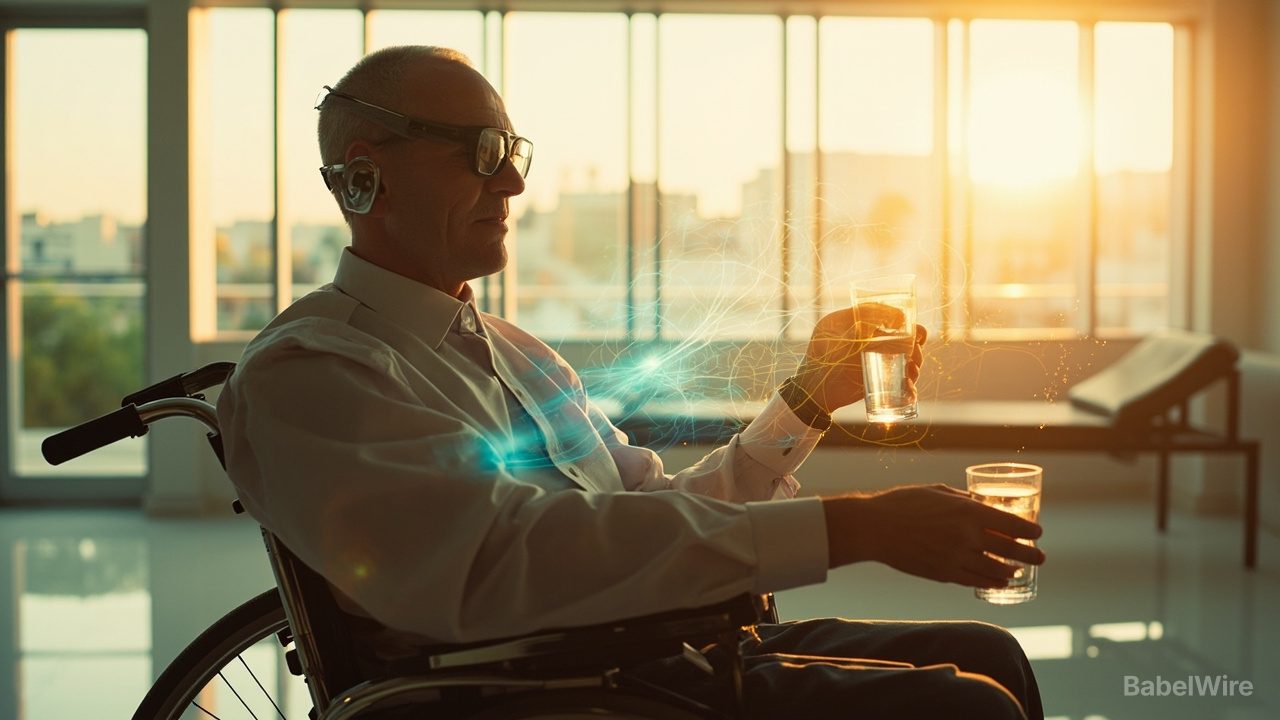
Neuralink released its first comprehensive six-month clinical data today from the company's second human patient, identified as 'P2' — a 34-year-old man with C4-level quadriplegia from a cycling accident in 2023. The results, published in the New England Journal of Medicine and presented at a press conference in Menlo Park, represent the most significant recovery of motor function ever achieved through a brain-computer interface (BCI).
Quantified Milestones The data reveals remarkable benchmarks: - Self-feeding: P2 can now independently feed himself using a robotic arm controlled entirely by neural signals, with a success rate of 92% across 200 trials. - Typing speed: Neural text entry has reached 40 words per minute with 96% accuracy — comparable to average smartphone typing. - Wheelchair navigation: After a software update in month four, P2 achieved the ability to drive a motorized wheelchair through a 50-meter obstacle course in under 4 minutes with only neural commands. - Sensory feedback: The implant's stimulation capability has restored partial tactile sensation in P2's right hand — the first time a commercial BCI has demonstrated bidirectional sensory-motor function.
Technical Advances The improvements over Neuralink's first patient (P1, implanted in January 2024) are substantial. P2's implant — the N2 model — features 2,048 electrodes (double the original), a redesigned wireless charging coil that supports continuous operation without removal, and an AI-powered decoder that adapts to neural drift in real-time.
"Six months ago, I couldn't move anything below my shoulders," said P2 in a statement. "Today I fed myself lunch. It's not perfect — my hand still trembles — but I haven't fed myself in three years. This is everything."
Regulatory and Safety Profile Neuralink reported one serious adverse event — a suspected infection at the implant site in month two that resolved with antibiotics. The company emphasized that no electrode degradation, immune rejection, or cognitive side effects were observed across the six-month period. The FDA has since expanded Neuralink's Investigational Device Exemption to allow enrolling three additional patients.
The Road Ahead Neuralink CEO Elon Musk announced plans for a third-generation implant (N3) in clinical trials by early 2027, targeting not only motor recovery for paralysis but also visual prosthetics for blindness. "P2's results prove the fundamental architecture works," Musk said. "The next step is scaling — making this available to hundreds, then thousands."