A Fire Sprinkler That Floods the House
"A fire starts in one room, but instead of containing the danger, the sprinkler system floods the entire house. The response causes far more damage than the original threat."
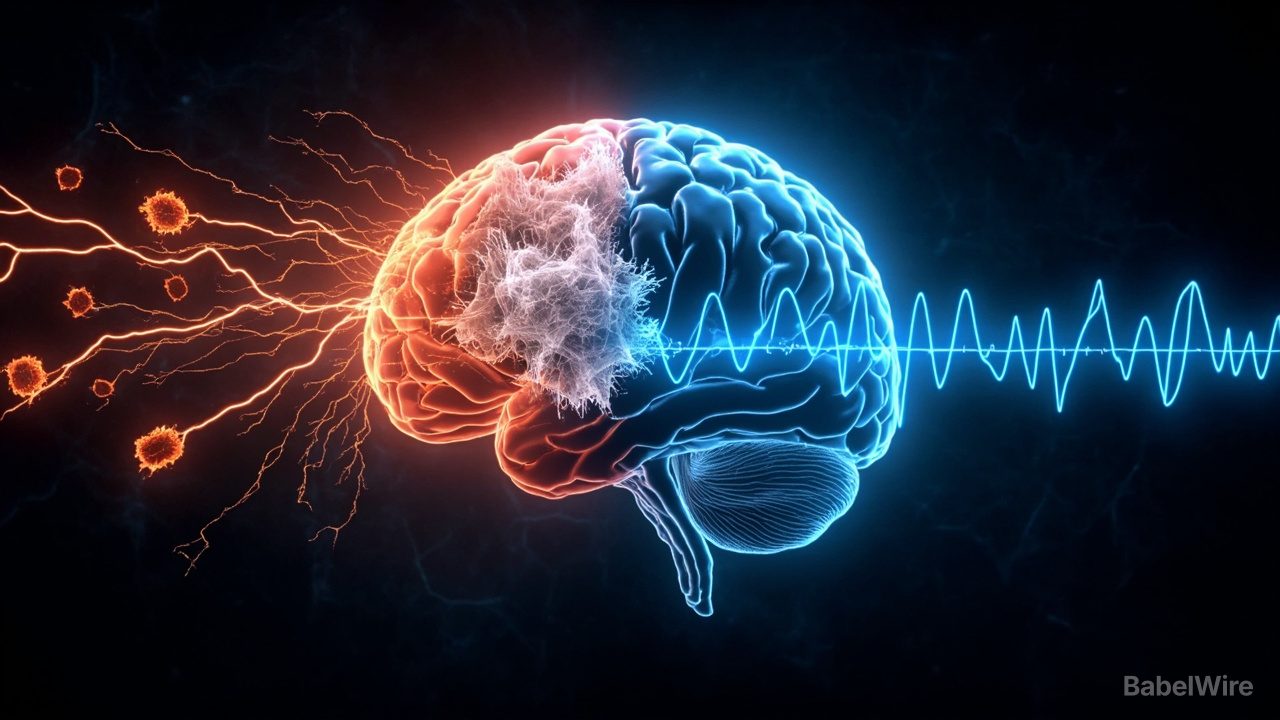
This is how Shannon L. Macauley, Ph.D., an associate professor of physiology at the University of Kentucky, describes the mechanism her team has uncovered in Alzheimer's disease. The amyloid plaques—sticky protein deposits that accumulate in the brain—are the small fire. The microglia—the brain's immune cells—are the sprinklers. And their overreactive response may be causing more damage than the plaques themselves.
The Discovery
For decades, sleep disruption in Alzheimer's disease was attributed to dying neurons or the physical presence of amyloid plaques. The new study, published in Alzheimer's & Dementia, turns that assumption on its head.
Researchers led by Macauley and first author Nicholas J. Constantino, Ph.D., found that microglia—not the plaques themselves—are the primary drivers of sleep loss in mouse models of Alzheimer's disease.
"Basically, we showed that it is not the plaques themselves, or solely dysfunctional neurons, that cause sleep loss but actually microglia," said Macauley. "Microglia are immune cells that, when they respond to plaques, kick off this elaborate cascade of inflammation, as if the microglia are partying all night, and keeping the brain awake."
The Experiment
The researchers compared mice genetically predisposed to develop amyloid plaques with normal aging mice at two time points: six months (when plaques first emerge) and 18 months (advanced disease). Using tiny head-mounted devices that recorded EEG and EMG, they tracked precisely when each mouse was awake, in deep restorative sleep, or in dreaming sleep.
They also used light-sheet microscopy to create detailed 3D maps of plaque distribution and immune cell activity across the entire brain.
To test whether microglia were directly responsible, the mice received Pexidartinib (PLX3397), a cancer drug that blocks a survival signal required by microglia. After 14 days, about 87% of the brain's immune cells had been temporarily removed.
The result was striking: mice with Alzheimer's-like pathology slept more than two additional hours each night. Their periods of restorative NREM sleep became longer, increasing opportunities for the dreaming sleep that supports memory formation.
A Ceiling Effect
Perhaps the most surprising finding was that sleep disruption reached a ceiling early in the disease. Despite plaque burden more than doubling between 6 and 18 months, sleep loss did not intensify.
"I expected that as plaque burden became more severe, sleep disruption would also worsen," said Constantino. "The disruptions in sleep and cortical EEG activity that occur at 6 months, when plaques first emerge, did not worsen by 18 months, despite more than double the amount of plaque burden."
This suggests that the initial inflammatory response to early plaques triggers the disruption, while additional plaques do not necessarily increase it further.
Why NREM Sleep Matters
The study distinguished the effects of normal aging from Alzheimer's pathology. Aging primarily reduced REM sleep (dreaming, memory consolidation). Alzheimer's pathology selectively disrupted NREM sleep—the main restorative stage.
"That restorative sleep is super important for physical repair, learning and memory and washing out the toxins of the day," Macauley said. When Alzheimer's patients lose this stage, they lose their brain's primary cleaning cycle.
What's Next
The improvement occurred without reducing amyloid plaque levels, proving that the inflammatory response—not plaque burden alone—is a reversible source of sleep disruption.
The team is now studying ways to calm microglial overactivity without eliminating the cells entirely, including evaluating existing medications like Metformin and the anti-seizure drug Stiripentol. The goal: quiet the immune response, restore sleep, and improve quality of life before memory loss becomes apparent.
Crucially, the researchers identified EEG brain wave patterns that differentiate Alzheimer's pathology from normal aging. This could lead to affordable, portable EEG-based screening tools.
"Portable EEG systems could allow us to monitor people in their home environments and potentially screen for changes associated with Alzheimer's disease, without the initial need for expensive or invasive tests," Macauley said.
Sources
- scitechdaily.comSciTechDaily - Scientists Found What May Be Keeping the Alzheimer's Brain Awake
- sciencedaily.comScienceDaily - Alzheimer's breakthrough: Scientists restore two hours of sleep
- news-medical.netNews-Medical - Microglia found to drive sleep loss in Alzheimer's
- pubmed.ncbi.nlm.nih.govAlzheimer's & Dementia - Early microglial response to amyloid plaques drives sleep loss (2026)