A Flash a Mile Underground
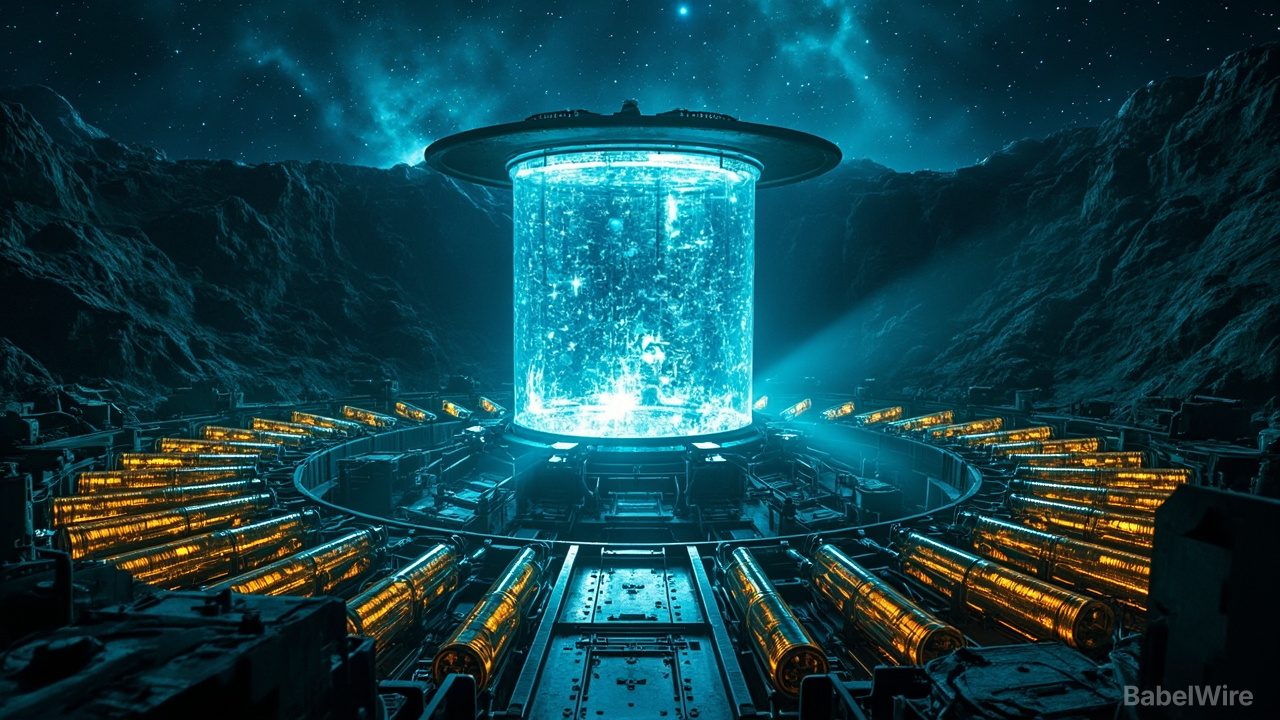
On June 16, 2023, 39 seconds after 3:22 PM, something happened a mile beneath the Black Hills of South Dakota that has taken three years to announce. A sealed tank of ultracold liquid xenon in the LUX-ZEPLIN (LZ) detector registered a sudden flash of light and an accompanying electric charge — the unmistakable signature of a particle colliding with a xenon atom's nucleus.
The LZ experiment, the world's most sensitive dark matter detector, was designed to catch exactly this kind of event: a hypothetical particle called a WIMP (weakly interacting massive particle) slamming into ordinary matter. But every previous candidate event across decades of searching has turned out to be background noise — stray neutrons, radioactivity, cosmic rays.
This one is different.
Why Physicists Are Excited
The event deposited 248 keV of energy in the detector — far above the 50 keV ceiling that most WIMP searches focus on. LZ's collaboration analyzed 220 days of data collected between March 2023 and April 2024, extending their search into this higher-energy regime. After "salting" the data with synthetic events to prevent bias, they unsalted it and found one lingering signal.
"After we unsalted, there was a single event that was left," said Richard Gaitskell, LZ spokesperson and professor of physics at Brown University. "Obviously, that was very exciting."
At 2.6-sigma significance, there is approximately a 0.5% probability the event is a statistical fluke. Particle physics demands 5-sigma (a one-in-3.5-million chance) to declare a discovery — so the team is emphatically not claiming to have found dark matter. But the event defies explanation by known backgrounds.
"Everything is working as intended," said Knut Mora, a physicist at the University of Zurich and LZ member. "We made our meter so that the needle would jump when it saw an event like this."
The WIMP That Shouldn't Exist
Here's the puzzle: standard WIMP theories predict that if a particle this energetic were detected, the experiment should also have recorded dozens of lower-energy events. LZ saw only one. That means if this is a WIMP, it is an unusual one — possibly interacting through "inelastic scattering" or "momentum-dependent" processes that theoretical extensions have predicted but that have never been observed.
"There are well-motivated theoretical extensions that could potentially account for this single event," said JiJi Fan, an associate professor of physics at Brown whose theoretical work is cited in the LZ paper.
The candidate particle would need to weigh at least 200 GeV (gigaelectronvolts) — more than 200 times the mass of a proton — placing it in the "heavy WIMP" territory that many researchers had all but abandoned.
A Closing Window
The timing matters. Detectors like LZ are approaching a sensitivity threshold where they will begin to be overwhelmed by neutrinos — ghostly particles produced by the Sun and Earth's atmosphere that can mimic dark matter signals. Once that "neutrino fog" sets in, the WIMP search becomes exponentially harder.
"Here's your last window of opportunity to see a WIMP — if it's not there, you have to close up shop at some point in the next 10 years," said Juan Collar, a physicist at the University of Chicago. "This could be the beginning of something spectacular."
What Comes Next
LZ has accumulated over 700 days of blinded data — more than three times the dataset used in this analysis. That data will either reinforce the signal or dissolve it. Two competing experiments — PandaX-4T in China and XENONnT in Italy — can provide independent confirmation.
For now, the collaboration is proceeding with characteristic caution. "You get these flashes of, like, 'Wait, could this really be it?'" Mora said. "But it would be damaging to the analysis to be in that mindset."
After 40 years of empty-handed searching, the dark matter community has its first genuine mystery in a long time.



