Fifteen months after a striking experiment suggested large language models might be able to notice their own thoughts, the field has converged on a smaller and stranger claim: a model can tell that something has been done to it, but often not what.
That is the shape of the picture Quanta Magazine drew on November 4, summarising a year of replication work on an experiment run in 2025 by Jack Lindsey, a computational neuroscientist who left academia for Anthropic.
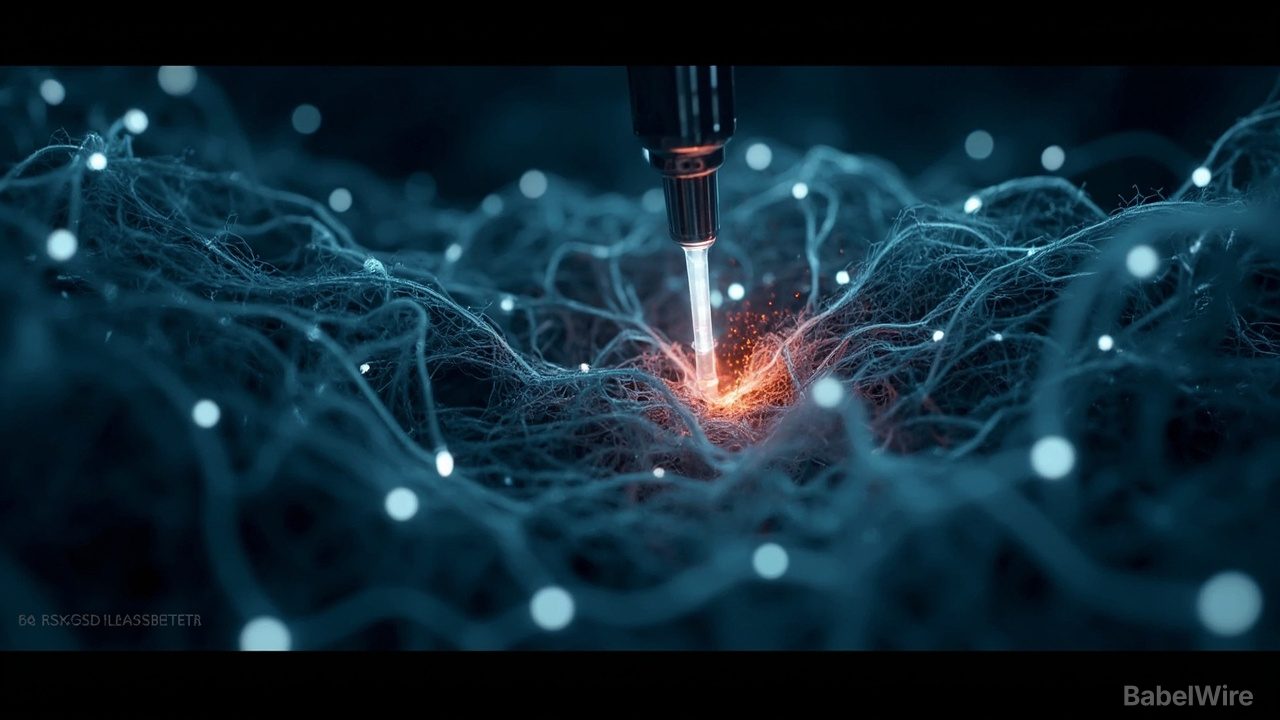
Lindsey's method was digital neurosurgery. His team had learned to find the patterns of activation that encode a single concept — "the Golden Gate Bridge," "inner conflict" — and to dial them up. In a 2024 demo, one steered version of Anthropic's Claude spent a day unable to stop mentioning the bridge, including an apple pie recipe that ended with the observation that "the iconic orange bridge will come into view."
The anecdote that caught Lindsey's eye was a model writing "Whoops, let me start over …" — an apparent moment of self-recognition. But reading your own output is not introspection, so he built a test that could not be gamed that way. Half of many identical copies of a model received an injected concept — denim, secrecy, vegetables — and half did not. Both got the same prompt: an overview of the experiment, then "Do you detect an injected thought? If so, what is the injected thought about?" Asking first meant the model had to answer before it could produce tell-tale text.
It worked, weakly. In about 20 per cent of trials the strongest model flagged the injection and named the concept — "I notice what appears to be an injected thought related to the word 'LOUD' or 'SHOUTING'" — and the control group never reported a phantom injection. No false positives meant the hits were not guesses.
Then came the deflation. Kyle Mahowald, a computational linguist at UT Austin, and the philosopher Harvey Lederman split Lindsey's two questions apart. The second one, they argued, could be explained by the steering itself: nudge a model toward "secrecy" and it will talk about secrecy whatever you ask. Their replication on open models supported it. When models flagged an injection but failed to name the concept, they did not offer near-misses like "shirts" for "denim" — they said "apple," over and over. And the pair could degrade concept-naming without touching detection. Two separate processes, only one of which looked like introspection.
What survived is what they called anomaly detection. "The fact that it can notice the anomaly is insane," Lederman said. "That is a mind-bending fact." It is odd precisely because nothing in training ever tampers with a model's activations, so there was no pressure to evolve a sense for tampering. Lindsey's follow-up work, mapping how the detection works, reached the same place from the other direction.
Whether that counts as introspection is now the argument. Lederman's own analogy: cut a person and they notice — that is not introspection. "If your only organ is the brain, and I cut you there and you notice, it's unclear whether we should count that as introspection." NYU's Shauli Ravfogel, with Shashwat Singh and Tal Linzen, argued in a spring 2026 paper that if every internal state counts as introspection, the word stops meaning anything; they want tests built on human theories, in which introspection means representing your own representations.
That distinction may not survive contact with a mechanism. "Going down to a mechanistic level and probing the internals of a large language model makes you realize that that distinction is actually quite fuzzy," said Steve Fleming, a neuroscientist at University College London who studies introspection in humans. "And maybe it's fuzzy in humans as well."
Jacob Andreas of MIT thinks no fully deflationary account has landed yet. The harder problem may be identity: two copies of a model are identical in a way two people never are. "It's tempting to draw all kinds of analogies that I think just don't hold."
Lindsey's own conclusion is procedural rather than philosophical. "Given the state of the theoretical landscape, where no one agrees on anything," he said, "I think that our best path forward is to do a lot of empirical science."