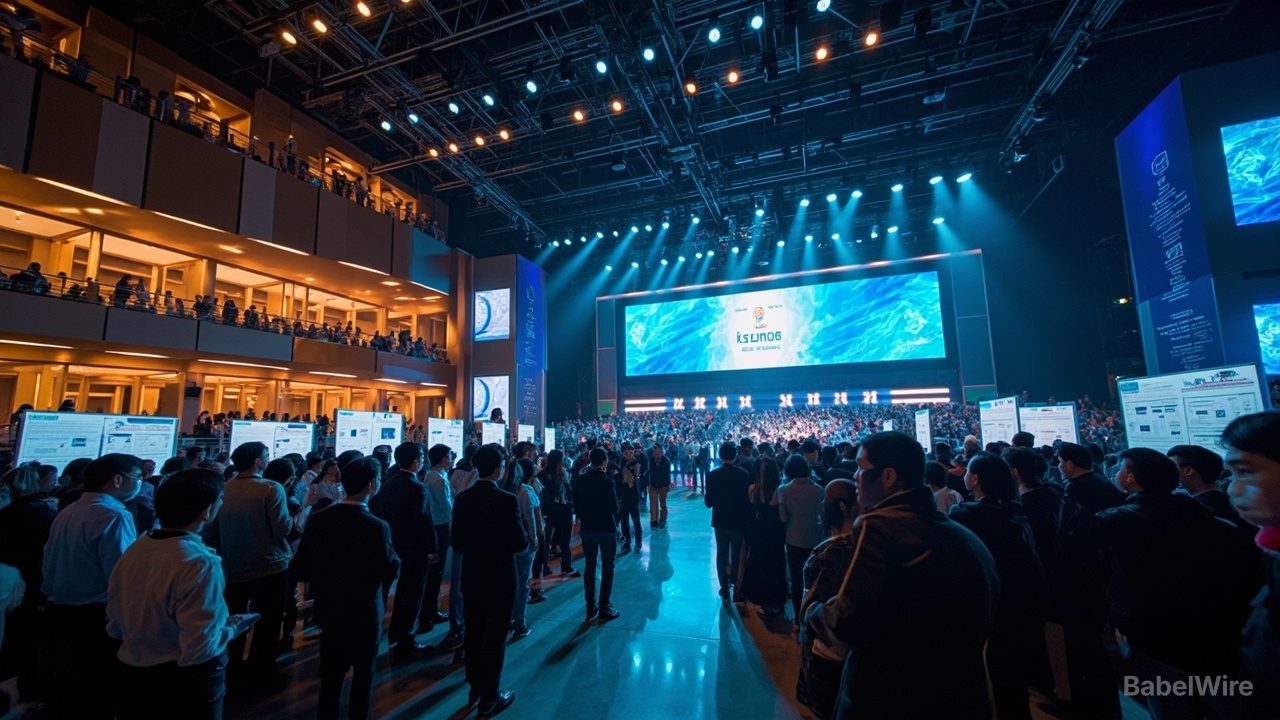
Seoul, South Korea — The 43rd International Conference on Machine Learning (ICML 2026) draws to a close today at the COEX Convention & Exhibition Center in Seoul, capping a historic week for the field. The conference received a staggering 23,918 paper submissions — more than double last year's volume — of which 6,352 were accepted, yielding an overall acceptance rate of 26.6%.
Diffusion Models Sweep Top Honors
Two papers on diffusion models claimed this year's Outstanding Paper awards. The first, "The Flexibility Trap: Rethinking the Value of Arbitrary Order in Diffusion Language Models" by Zanlin Ni and colleagues, reveals that the ability of diffusion large language models (dLLMs) to generate text in any order — long considered a feature — can actually hurt reasoning. The team proposed JustGRPO, a training method that restores left-to-right generation order during reinforcement learning while preserving the speed of parallel decoding at inference.
The second winning paper, "High-Accuracy Sampling for Diffusion Models and Log-Concave Distributions" by Fan Chen, Sinho Chewi, Constantinos Daskalakis, and Alexander Rakhlin, proves that diffusion models can generate highly accurate samples far more efficiently than previously believed. Their new algorithm, first-order rejection sampling (FORS), bypasses the density evaluations that earlier high-accuracy methods depended on, potentially making diffusion models faster and more practical for real-world deployment.
Test of Time: The Paper That Quietly Shaped Modern AI
The conference's Test of Time Award went to "Asynchronous Methods for Deep Reinforcement Learning," published in 2016 by Volodymyr Mnih, Adrià Puigdomènech Badia, Mehdi Mirza, Alex Graves, Timothy Lillicrap, Tim Harley, David Silver, and Koray Kavukcuoglu. The paper's asynchronous RL framework has become a cornerstone of how large language models are post-trained today — an influence that was not widely anticipated at the time of publication.
Alignment, Deepfakes, and the Shape of Things to Come
This year's Outstanding Position Paper award tackled a provocative question: "The Alignment Community is Unintentionally Building a Censor's Toolkit," by Sarah Ball and Phil Hackemann, argues that the primary tools built to ensure AI safety can be weaponized for censorship, backed by real-world evidence. An honorable mention paper, "AI/ML Deepfake Research is Misaligned with AI Generated Non-Consensual Intimate Imagery," highlighted the growing gap between deepfake detection research and the actual harms victims face.
Five additional papers earned Honorable Mentions, covering topics from deception probing in RL-trained models to the mathematics of grokking in neural networks. With ICML 2026 wrapping up today, the research community now turns its attention to NeurIPS later this year — but the sheer scale and breadth of work presented in Seoul signals that machine learning research is accelerating at an unprecedented pace.