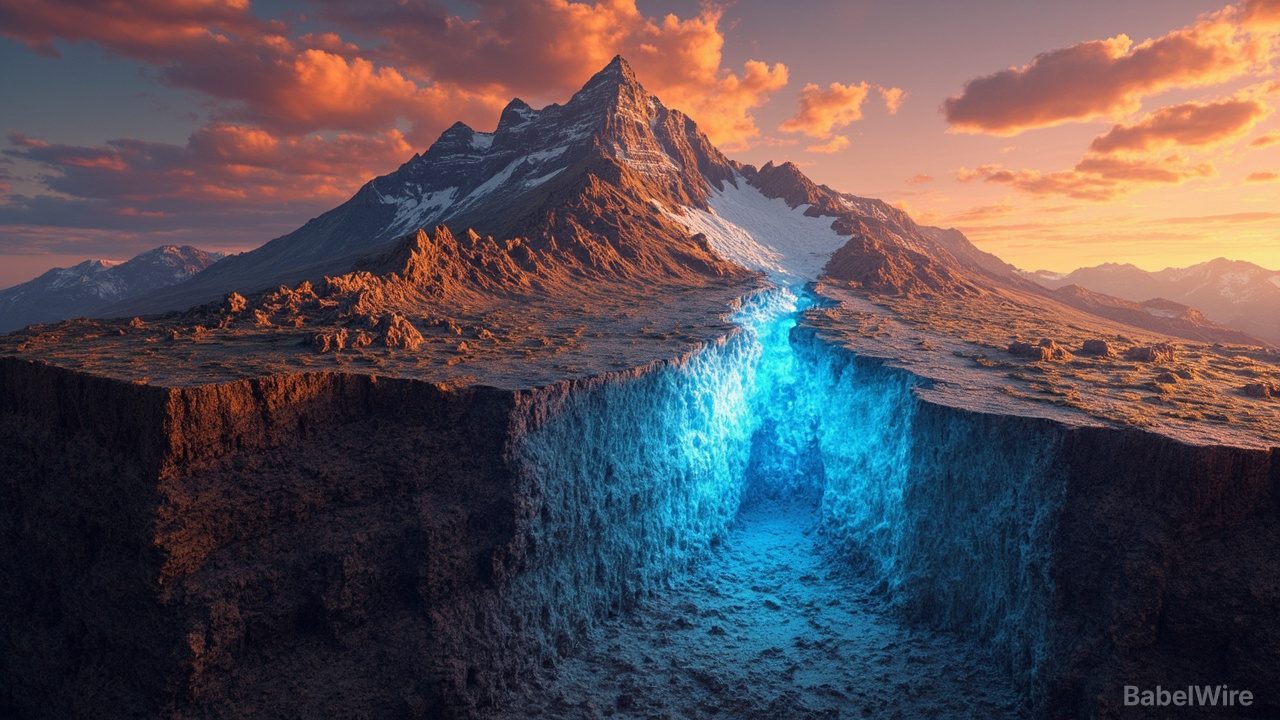
Beneath the rocky slopes of Mount Timpanogos in Utah's Wasatch Range lies a far larger ice deposit than anyone walking across its surface might suspect. University of Utah geologists have created the first detailed 3D map of the Timpanogos Rock Glacier using precise gravity measurements, revealing that the formation is 83% ice and holds approximately 1.5 million cubic meters of frozen water — enough to fill roughly 600 Olympic swimming pools, or about the same volume as the Great Pyramid of Giza.
The researchers, led by former graduate student Bronson Cvijanovich under Professors Michael Thorne and Leif Anderson, collected gravity measurements at 232 locations across the glacier during fall 2024. Using a state-of-the-art gravimeter, they detected extremely small differences in the gravitational pull of rock versus ice, then developed a new Bayesian statistical method to reconstruct the glacier's internal ice in three dimensions.
"There's a lot of ice that's hidden in Utah's mountains," Anderson said. "When we are high in the mountains and walking across loose rocks or rubble, you don't realize there could be 120 feet of ice buried beneath your feet."
The team also developed a new mathematical model showing that rock glaciers form when falling debris buries persistent snow in steep mountain valleys, preserving it for thousands of years. Their analysis indicates these glaciers are not Ice Age relics but rather reservoirs that developed during the millennia after the major Ice Age glaciers retreated.
Timpanogos Rock Glacier is one of 836 identified across Utah through satellite imagery. Extrapolating from their detailed measurements, the researchers estimate that the roughly 50,000 known rock glaciers worldwide could collectively contain about 48 gigatons of water — equivalent to 1 billion metric tons. Within Utah alone, rock glaciers may store about 1 gigaton, or approximately 815,000 acre-feet.
The findings, published in the Journal of Geophysical Research, suggest these hidden ice formations could represent a significant and previously underestimated freshwater reserve at a time when western water supplies face growing pressure from climate change.
Sources
- sciencedaily.comScientists find a huge hidden ice reservoir beneath Utah's mountains | ScienceDaily
- attheu.utah.eduUtah ranges may store a billion tons of hidden ice | University of Utah
- phys.orgUtah mountain ranges may store a billion tons of hidden ice | Phys.org
- sltrib.comUtah's mountains may be hiding a billion tons of ice | Salt Lake Tribune



