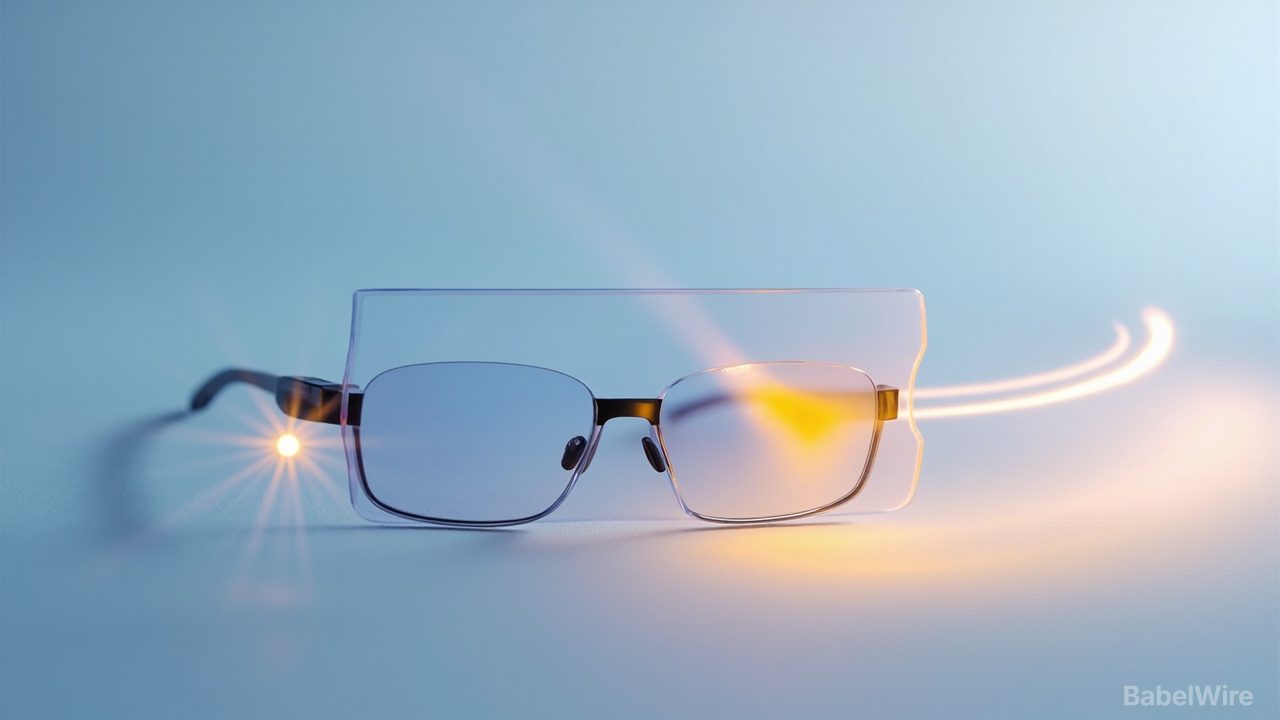
Google opened preorders on Thursday for its first Gemini-powered smartglasses — a collaboration between Google, Samsung, Warby Parker and the Korean eyewear brand Gentle Monster — with prices starting at $395.
Warby Parker, which is selling the glasses in the United States only, has designed three frames: Alden, Reid and Wren, in Pine, Saddle and Jet Black, with optical or sun lenses, from $395. Gentle Monster has gone further with six styles in dark red, pink, grey and yellow, with clear, tinted, blue or brown lenses, starting at $449 and sold in the US and South Korea. Google says every frame weighs roughly 41 grams before lenses, which is close to the top of the range for ordinary glasses. Devices ship and reach store shelves on December 10.
There is no display in the lenses, so the experience is closer to the Ray-Ban Meta formula than to the augmented-reality prototypes Google showed off in earlier years. Interaction is by voice — “Hey Gemini” — or by tapping a touch-sensitive area of the frame, and the glasses connect to the full Gemini assistant, with its access to the wearer's Google data and preferences. A 12-megapixel wide-angle camera supplies the visual input, while open-ear speakers and directional microphones are meant to keep the interaction to the wearer. Gemini Guided Vision will provide conversational audio descriptions for people who are blind or visually impaired.
Compatibility at launch is narrow: any iPhone from the 13 Pro onward, or a Pixel 7 or newer, or a Galaxy S or Z device running Samsung's One UI 9 or later.
The harder sell is privacy, which has dogged smartglasses since the Google Glass era. Google says its approach “respects privacy on both sides of the lens”, and it has built guardrails that go further than Meta's in several places. A recording light is on whenever the camera is active, and the glasses detect if that light has been covered or modified and refuse to activate the camera — as Meta's glasses also do. There is a physical off switch as well.
The terms of use require owners not to record people without consent or in sensitive places, and Google says it may remotely disable glasses belonging to users who break those rules. No app in the Play Store will be allowed to live-stream video to social media from the glasses, and Google says YouTube live is not supported either. Real-time facial recognition is off the table, and video is automatically redacted — faces blurred — before it is sent to Google's servers for processing.
On the wearer's side of the ledger, Google says images and video captured by the glasses will not be stored in Gemini history and will not be used to train AI models or target advertising. Data is encrypted on the device and in transit, but not on Google's servers; the company says it is working to bring Private AI Compute to the glasses so that data stays isolated even during processing. Voice interactions, Google concedes, do not receive the same protection as camera data.
The catch, as Ars Technica's reviewer notes, is that the value of the glasses depends entirely on Gemini getting things right — and Google's assistant still fails at simple tasks such as adding a calendar appointment or identifying an object in a photograph. Without a screen, there is nothing to check the answer against.
Sources
- arstechnica.comGoogle pushes privacy angle as Gemini-powered smartglasses debut starting at $395 (Ars Technica)
- cnn.comGoogle knows smart glasses have a privacy problem. Here's how it's trying to fix it (CNN)
- tomsguide.comGoogle and Samsung's AI glasses just launched starting at $449 (Tom's Guide)
- nytimes.comGoogle Is Trying Smart Glasses Again. I Tried Them On. (NYT Wirecutter)