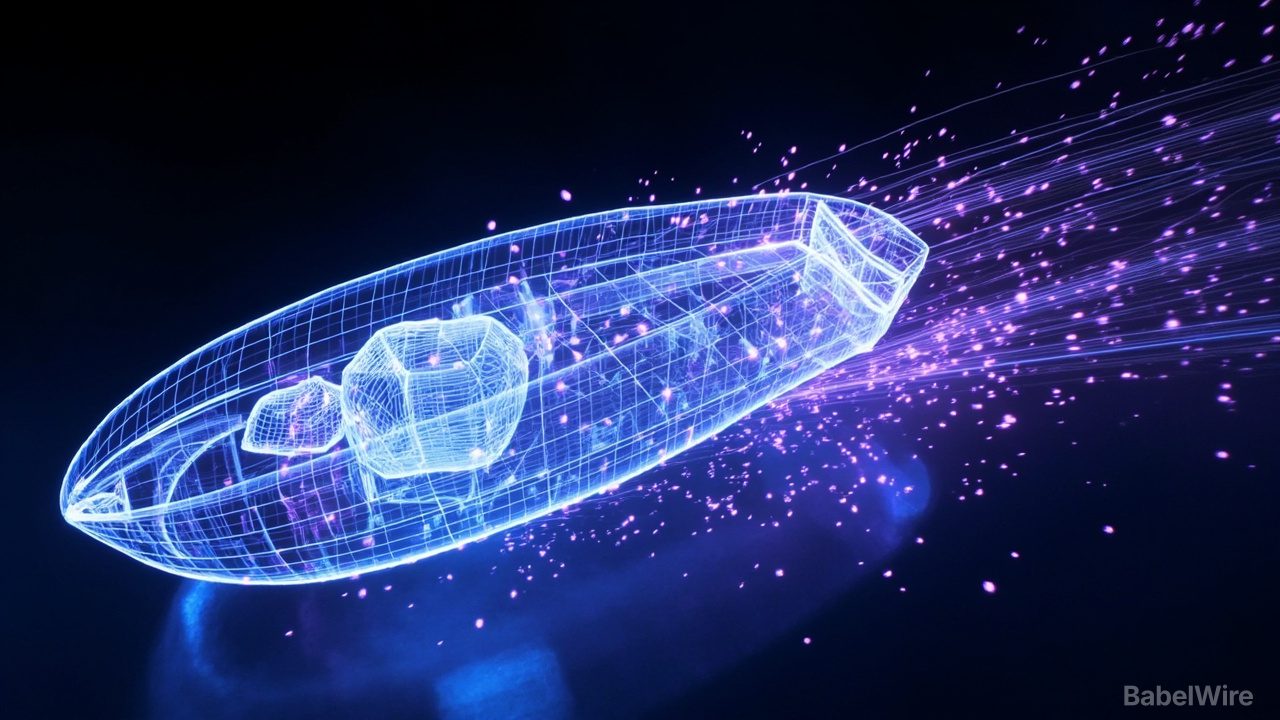
AI models can write, draw and generate 3D objects — but they still struggle to understand physics well enough to simulate how a car crumples in a crash or how a boat hull handles waves. A new pre-training approach from MIT's Computer Science and Artificial Intelligence Laboratory (CSAIL) and Tsinghua University, called GeoPT, gives simulation models a 'feel for physics' by reenacting everyday mechanical interactions in 3D.
GeoPT's knowledge comes from 'synthetic dynamics': 1.3 million samples in which tiny spheres move at various speeds and angles until they stop on the surface of a complex 3D shape — like learning physics with marbles and action figures. Pre-training on these particle–object interactions lets models generalize to real physics tasks with far less data.
In benchmarks, GeoPT reached peak performance twice as fast as leading models while training on up to 60 percent less data. On a boat-hull dataset testing both air and waves, it needed 60 percent fewer labeled data and hit peak accuracy four times faster than top baselines. It also simulated how fighter jets respond to wind, how cars deform after collisions, and even how light passes through an object it had never seen — with high-fidelity simulations of over 100 million mesh points computed in seconds.
'We believe physics is the third modality for AI models, after text and pixels,' says Minghao Guo, MIT PhD student, CSAIL researcher and co-lead author. The team presented the paper at the International Conference on Machine Learning in July and sees GeoPT as a step toward a physics foundation model: a backbone trained on vast data that could help engineers test vehicle and robot designs without costly physical experiments — and eventually model weather patterns and generate realistic videos. Co-authors include Kaiming He and senior author Wojciech Matusik.