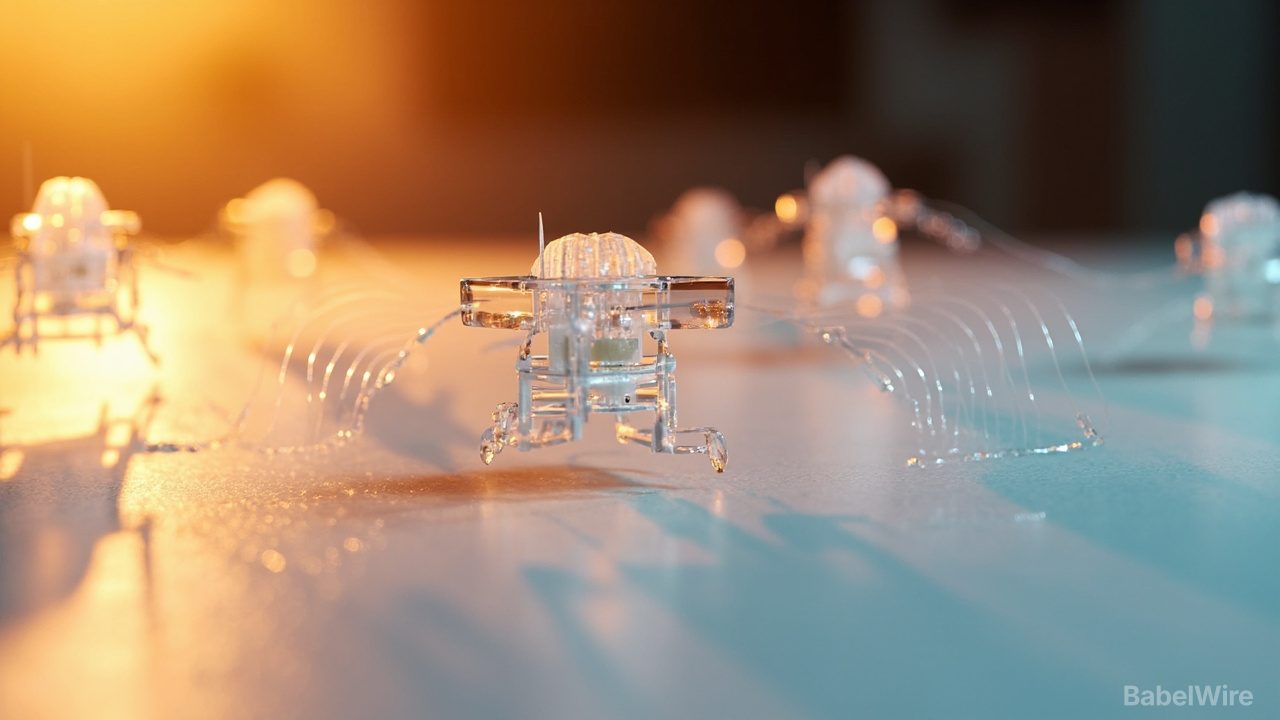
Researchers at EPFL's MicroBioRobotic Systems (MICROBS) Lab have developed a new propulsion method for tiny robots that uses sound waves instead of motors, gears, or batteries. The work, published in Science Advances, demonstrates hollow acoustic cavities that convert sound into directional thrust, enabling miniature boats and ultralight flying vehicles to move and steer themselves.
The innovation draws on Helmholtz resonance — the same physics that produces sound when you blow across the neck of a bottle. When sound waves excite air inside a carefully shaped cavity, the oscillating air is forced out as a concentrated jet, while incoming airflow is more diffuse. This imbalance generates thrust.
At the centimeter scale, the team built miniature boats equipped with up to three cavities, each tuned to a different audible frequency and positioned to push the boat in a particular direction. By changing the frequency of sound waves from a speaker, researchers could selectively activate different cavities to move the boats, steer them around obstacles, and even program them for autonomous navigation.
Using 3D nanoprinting, the team created microfliers — ultralight flying vehicles with three microscopic cavities integrated directly into their polymer structures. One design weighing just 150 micrograms generated direct upward thrust like a rocket. Another combined cavities with tiny blades that spun at up to 13,000 revolutions per minute, producing stable helicopter-like lift.
Because the devices rely on hollow cavities rather than motors or magnetic components, they can be made extremely small and lightweight using various 3D-printing methods. The researchers say the concept is compatible with even further miniaturization, potentially enabling advanced designs that push the boundaries of robotics and aeronautics.
Lead author Junsun Hwang noted that multiple sound-responsive structures could be built into a single flexible device, with each reacting to a different frequency. This could allow specific parts of a device to move, bend, or vibrate, leading to shape-changing robotic devices that respond to sound.
The work was supported by the Swiss Government Excellence Scholarship and represents a step toward sound-responsive robotic matter — structures that can be transformed into functional machines through clever mechanical design rather than electronic components.



