Andy Alder and Arjun Mather were roommates at Stanford, both studied computer science, and then spent a decade each at Palantir. Alder led product design for a team of 800 building software for US defence and intelligence agencies; Mather was a senior vice president in the commercial practice. When they decided to start a company early last year, the partnership was not in question.
They found their subject where neither of them had worked: construction. Fewer buildings go up in the United States today than a few decades ago, while development costs have surged. "We've gone from dial-up internet to super intelligent AI, but our ability to build the physical world around us has actually decreased," Mather said.
Dream, as the company is called, came out of stealth on Thursday with $17 million in seed funding led by Andreessen Horowitz, alongside SV Angel, XYZ and Zigg Capital. The ambition is stated plainly: replace Autodesk's AutoCAD and Revit, the tools architects and structural engineers have used to draw buildings part by part for decades.
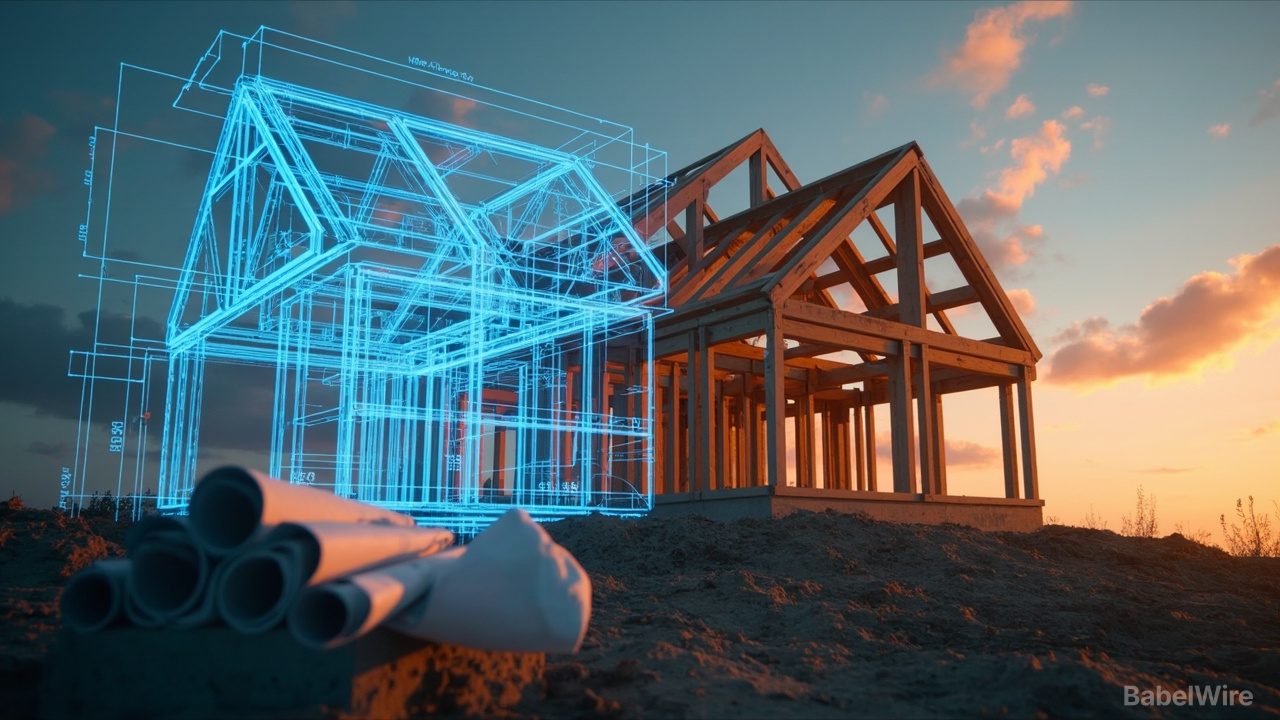
The technical core is a world model trained on more than 100 million square feet of building data pulled from municipal permit archives across the US. The difference from a language model that renders a picture of a house, the founders argue, is physics: the model knows what is inside the walls, what the beams are made of, how much weight they carry, and it accounts for plumbing and HVAC. Dream calls the approach "structural cognition."
It is already being sold — ten active projects in Texas and California, according to the company, to architecture, engineering and construction firms and developers, for concept design and cost estimation. Competitors exist: Motif, Snaptrude and Arcol are working on adjacent ideas, and the founders claim only theirs is a world model that designs whole buildings at once.
Kimberly Tan, a partner at Andreessen Horowitz, said the firm invested more than a year before launch, when Dream was an idea: "I have not seen anybody take the technical approach. They're doing everything based on their own models."
Why it matters: world models have so far been a story about robotics and autonomous driving — systems that understand how things move through the world. Dream applies the same idea to something unglamorous: building codes, material schedules, load assumptions. That is less exciting and probably closer to revenue, because the cost of an error is high and the feedback loop is short.
It also hits a real bottleneck. Architecture and engineering firms are not slow for lack of ideas; they are slow because every element has to be formally worked through and checked against code. If a model accelerates that step, value shifts from drawing to responsibility.
Which is exactly where the open questions sit. A generative design is not a structural calculation. In the US a licensed engineer carries liability with a signature and a seal, and no state has yet settled how a model fits into that chain. Ten projects across two states is a pilot, not a proof; and "world model" is currently a term every company defines for itself. The most durable part of the announcement is not the architecture but the permit-archive dataset — hard to copy, and precisely what a rival cannot assemble in a quarter.