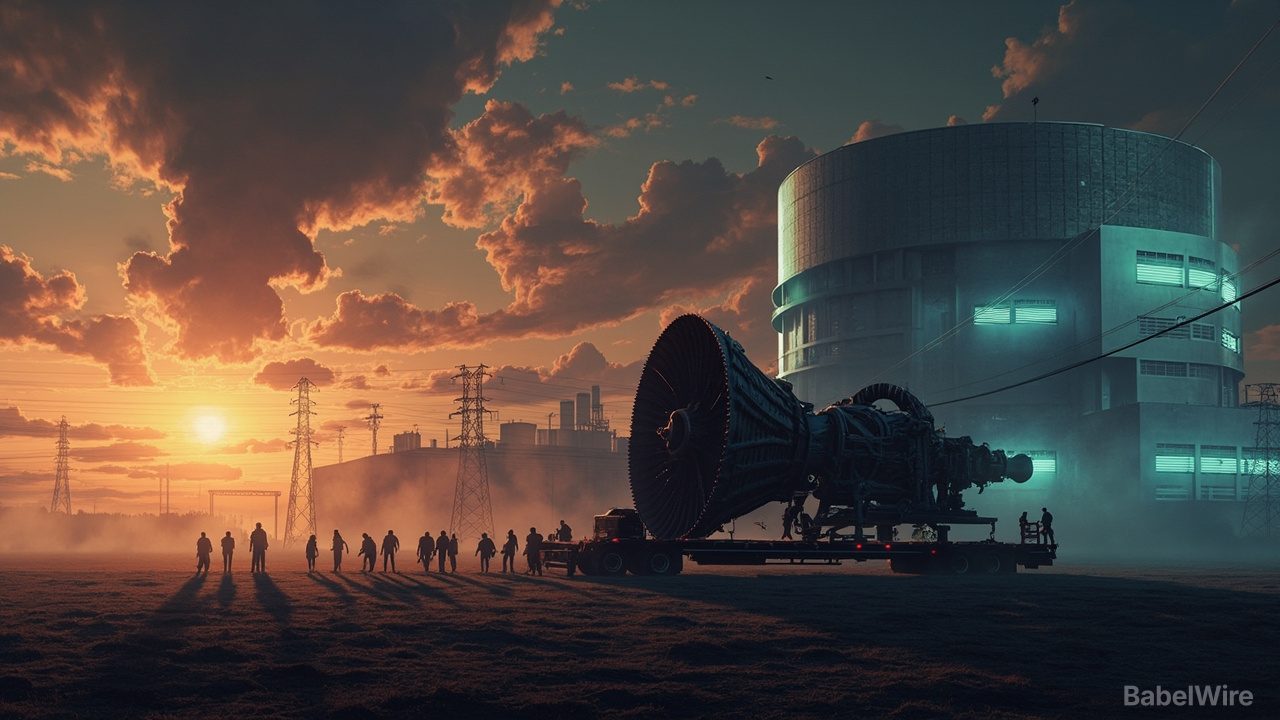
Anthropic has bought itself power plants — or at least the machines that will become them.
The company committed about $3.4 billion in late September to 1.7 gigawatts of heavy-duty gas-fired generators from OnePWR Solutions, a San Antonio, Texas equipment supplier, the Financial Times reported on Sunday. Reuters, which could not independently verify the deal, said neither Anthropic nor OnePWR responded to requests for comment.
What Anthropic bought was not the supplier. OnePWR's employees did not transfer and the company remains independent. But the transaction carried the engineering and construction capability needed to install the generators, according to a person familiar with the matter cited by the FT. That is the difference between owning a warehouse of engines and owning something that can put electrons on a wire.
The scale is the story. At 1.7 gigawatts, the order exceeds the output of a typical large nuclear reactor, and it works out to roughly $2,000 per kilowatt of capacity — a price that reflects both the equipment and the scarcity premium attached to anything that can generate firm power on a short timeline.
It also reflects a structural problem the AI industry has stopped pretending is temporary. Grid interconnection queues in the United States now run into the late 2020s in the most congested regions, and heavy-duty gas turbines are themselves backordered for years. A lab that waits for a utility to build generation is a lab that waits for its next model to sit unserved. Buying the equipment directly, and hiring the people who know how to bolt it down, compresses that wait.
Anthropic has been signalling the scale of the problem. Reuters reported in September that the company expects to spend more than $500 billion over the next decade building AI infrastructure. That buildout already includes a $19 billion, 20-year lease for a Kentucky data centre and a $50 billion partnership with Fluidstack to build capacity in Texas. Coverage of its October IPO filing has also noted on-site gas generation among its power plans, a model in which the campus makes its own electricity rather than buying it from the grid.
That model solves a scheduling problem and creates a different one. Turbines bought outright are usually accompanied by long-term fuel supply arrangements, which turns a technology company into an exposed buyer of natural gas — a commodity whose price is set by weather, export terminals and geopolitics rather than by compute demand. Permitting, air-quality rules and local opposition become operating risks rather than someone else's problem. And emissions accounting gets harder to explain: a renewable power purchase agreement is a contract, but a gas turbine behind the fence is a smokestack that regulators and host communities can see.
The financial logic is nonetheless straightforward. Every gigawatt of self-generated power is a gigawatt a lab does not have to bid for in a market where hyperscalers, utilities and now AI companies are competing for the same transformers, switchgear and turbines. Cutting out the intermediary also cuts out the intermediary's margin and, more importantly, its queue position.
What the reporting does not yet establish is nearly as important as what it does. There is no disclosed list of sites, no commissioning timeline, no split between continuous generation and backup duty, no expected cost per megawatt-hour, and no indication of how the fuel will be sourced or the emissions reported. Anthropic has not confirmed the deal at all; the account rests on FT reporting and a single person familiar with the matter.
For the wider industry, the direction of travel is unambiguous. For two years the constraint on frontier AI was chips. The constraint is now electricity, and the companies with the largest training runs have concluded that the fastest way to get it is to stop being a customer.
Why it matters: a $3.4 billion generator order is not a procurement detail. It is an AI lab taking on the capital structure, fuel risk and carbon profile of a power producer — and quietly redrawing what counts as core business for a model developer.