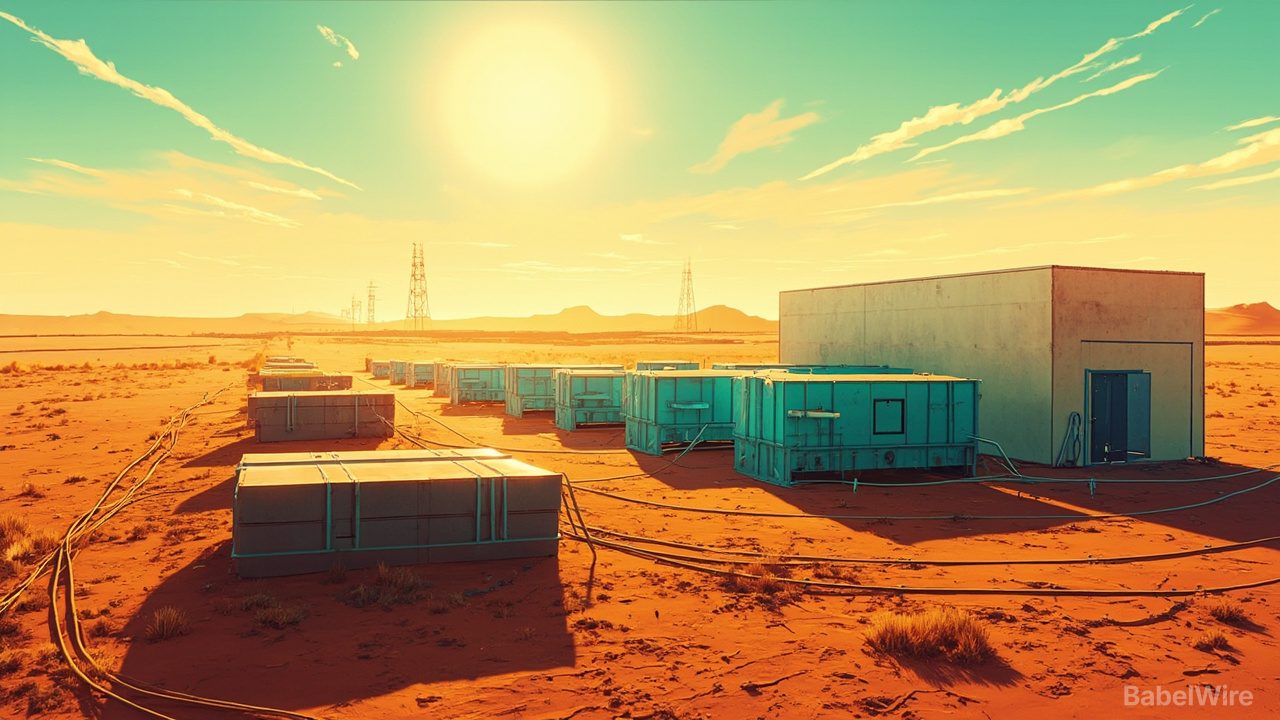
Data centers are learning to stop waiting for the grid. Ambrosia Energy plans to build a 10 GWh battery factory in Texas to supply off-grid data centers, TechCrunch reports — a bet that a meaningful share of AI computing will be powered by generation and storage sited next to the servers rather than by a utility connection.
The reasoning is arithmetic, not fashion. In the regions where AI capacity is being built, grid interconnection queues can run into years, and the equipment that connects a large load — transformers, switchgear, high-voltage lines — is itself scarce. Utilities that once welcomed large customers now sometimes tell them they cannot be served on the timeline the customer needs. Every month a data center sits unpowered is a month of capital that is not earning, which is why operators have started contracting their own generation: gas turbines, fuel cells, nuclear power agreements, and increasingly storage to smooth and firm all of it.
Batteries are the piece that makes on-site power behave like grid power. Generation alone is either intermittent or slow to modulate; storage turns it into something that can follow a training run's load swings and cover the gap when a turbine trips. That is the demand Ambrosia says it is building for: not grid-scale arbitrage in the usual sense, but industrial batteries designed for the particular duty cycle of a compute campus.
Texas is the obvious first market — a deregulated power market where large users can contract directly, an existing build-out of renewables and transmission, and a state government that has made itself the default destination for new load. The 10 GWh figure describes the plant's output capacity, which puts the project in the range of the larger battery factories now being planned, though the raw materials supply chain and the question of which cell chemistry will be used matter as much as the headline number.
The open questions are the usual ones for any 'behind the meter' project: whether self-generation plus storage is genuinely cheaper over a plant's life than a negotiated utility contract, what the emissions profile of the fuel behind it looks like, and whether the AI build-out stays at current speed long enough to fill the order book. Ambrosia is far from alone in answering them — which is itself the signal. The interesting part of the story is not this factory but the fact that an off-grid power supply chain now has enough customers to justify one.