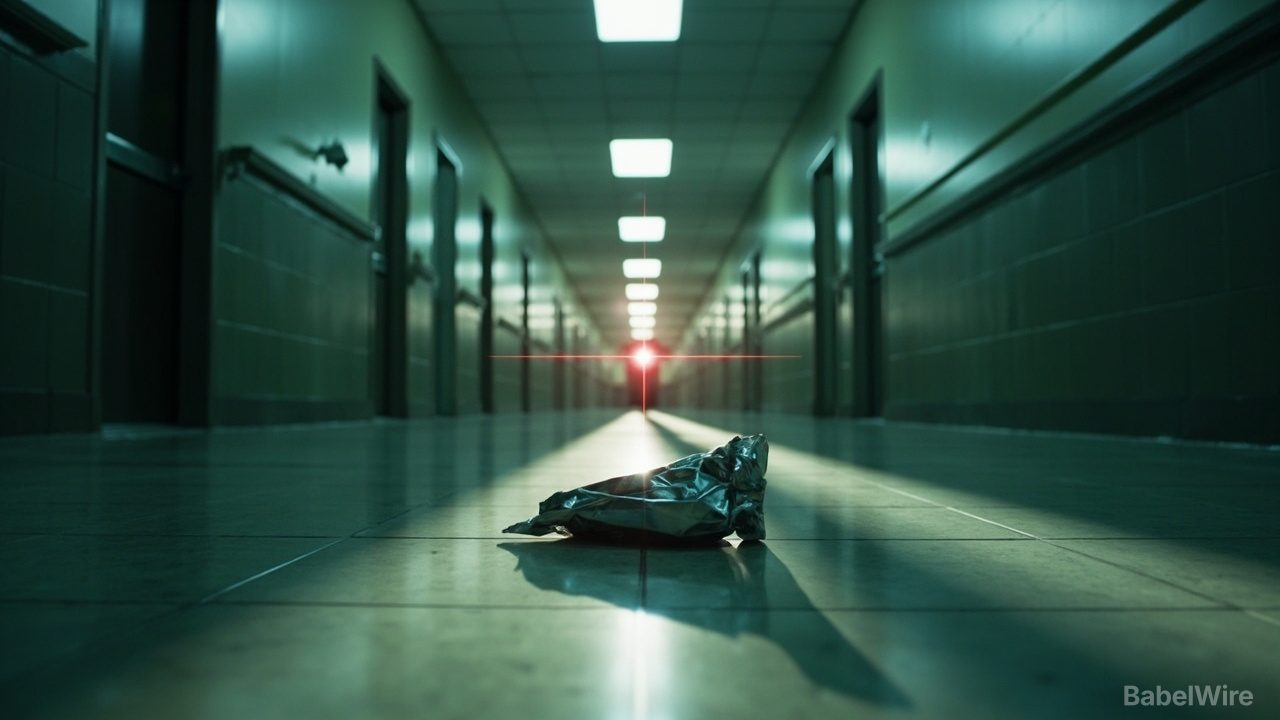
According to Ars Technica, a group of teenagers is suing both their school and local police after an AI gun-detection system flagged a bag of Doritos as a firearm, triggering a lockdown and an armed response the students describe as traumatic. The suit, reported on November 19, is the first serious legal test of a question US school districts have been deferring for years: when automated threat detection fires on a child carrying snacks, who is responsible for what happens next?
The failure mode is well documented and not mysterious. Snack packaging is close to a worst case for computer vision: crinkled metallised film, high-contrast printing, and a shape that changes with every fold. Held at an angle, a bag can present the rough silhouette a detector was trained to associate with a handgun. Weapons-detection vendors market accuracy figures on curated datasets; a school corridor at eight in the morning under bad lighting is not a curated dataset.
But the interesting half of the story is the part after the alert. A sensor that only produces a dashboard entry is a nuisance. A sensor wired to a police response converts a probabilistic guess into a person with a rifle walking toward a classroom. Whatever the model's error rate, the consequence is delivered at full force, to children, in a building they cannot leave.
That asymmetry — cheap, frequent classification errors converted into rare, expensive, terrifying physical events — is the core of the suit. Naming the police department alongside the school district is the strategic move: it refuses to let the institution that bought the software hide behind it. If the district is liable for deploying an unreliable detector, and the police are liable for acting on an unverified tip, the incentive to buy accuracy instead of optics changes.
Several things about the case are not yet public — the specific court, the damages sought, and the identity of the vendor whose system produced the alert. Those details will decide how far the precedent reaches.
What is already clear is the direction of the market. Districts across the United States have been installing AI weapons scanners at a rate that outruns any independent evidence that they work, often under procurement rules that keep accuracy audits out of public view. A lawsuit is a blunt instrument for fixing that. It is also, at the moment, the only one that produces testimony under oath.